

History of Railway Presented by Local Historian
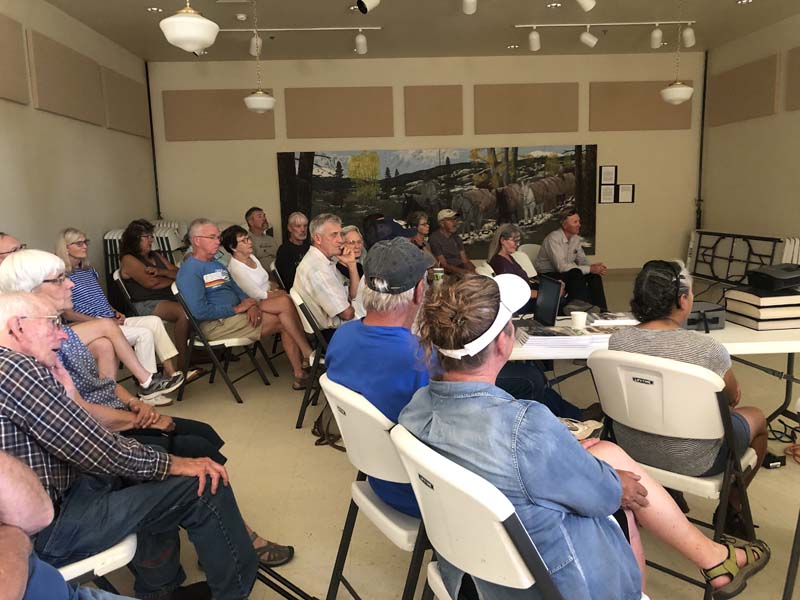
Our own History Corner’s, Dale Fisk, was introduced Tuesday night in New Meadows. Many people came to the Historic P&IN Depot to hear him give a presentation on the history of the railway between Weiser and New Meadows.
Mr. Fisk explained that before railroads, people didn’t travel much and mail was slow. In 1929, the first steam locomotive ran in the US and improved life so much that railroad building just exploded in the east. In 1869, the first transcontinental line between St. Louis and San Francisco was completed. The Idaho Northern Railroad was started in 1899.
Here is a little timeline of development in our area. Weiser was first settled in 1864 and Indian Valley in 1868. In 1874, a mail route was established to Warren. The first family came to Council in 1876. Calvin White came to Meadows Valley in 1877. The Oregon Short Line from Wyoming to Portland was completed in 1881. The first train reached Weiser in 1884. A line was started up Price Valley trying to go to the Seven Devils Mines. Sections of grade reached “Railroad” Saddle. The P&IN reached New Meadows in 1911.
Dale told of how the railroads would build a depot so the towns would relocate to where the depot was. It didn’t work in McCall, in 1914, when they built the depot in Lake Fork!
The telegraph followed the railroads and then news could travel instantly. Trains were more dependable than horses, could haul a lot more and mail delivery was faster. Trains also made social circles much wider.
At first, trains went 25mph and had to stop every 25 miles to get water. Horses averaged 5 to 6 mph. The Pony Express was the fastest and averaged 9 mph. By the late 1890’s, some trains could go 40 mph on flat straight stretches. The P&IN probably went 25-35 mph. Dale had a picture of a wrecked train by Glendale that was probably trying to go too fast around a corner.
Railroads hired specific ethnic groups to lay the tracks and paid about $1.25/day. The transcontinental line hired Chinese. Japanese were hired at Weiser for the P&IN. Then, Greek workers were hired when they got to Evergreen. Evidence of the bread baking ovens they used along the way can still be seen on the route.
People were upset when the railway bypassed Meadows to create New Meadows, but the original plan was to go on North, so why go clear across the valley first?
In 1913, the mail order business exploded. Finally, people in areas like ours could get packages. It had a huge affect on the national economy,
Between 1911 and 1920, the PIN had a lot of passengers. One reason was because the roads were so terrible. In 1923, they put a gas powered bus on the rail line. It was a lot less expensive. Next, came the cars called the Galloping Goose, maybe named because of the rocking feel. My mom actually used a Galloping Goose to travel back and forth from New Meadows to Weiser a few times a year when she was in school. In 1936, this portion of the railroad was renamed the New Meadows Branch of the Union Pacific but everybody still just called it the PIN. In 1946 the Union Pacific converted from coal to oil. During the 2nd World War passenger service picked up a lot because of the rationing of rubber and gas. After the war it dropped off almost completely. In 1947 they began running diesel electric trains on the New Meadows Branch. In July 1950, all passenger service was stopped on this line. Shay engines were still used for logging up Beaver Creek and Mud Creek. The P&IN shut down past Rubicon in 1979 and shut down completely in 1995 probably because the Boise Cascade Sawmill closed. The line then became the Weiser River Trail.
Mr. Fisk showed many pictures, added many details and had some interesting and exciting stories. He started writing “History Corner” in The Record Reporter in 1993 and is still at it! His love for history was inspired by his father’s constant storytelling of his childhood. He has written several books, the most recent with Don Dopf, “The P&IN The Pacific & Idaho Northern Railway”. You can purchase these at the Historic P&IN Depot in New Meadows and see more about our history on their website, historicpindepot.com.