

Meadows Valley Fire & EMS Practice Rope Rescue
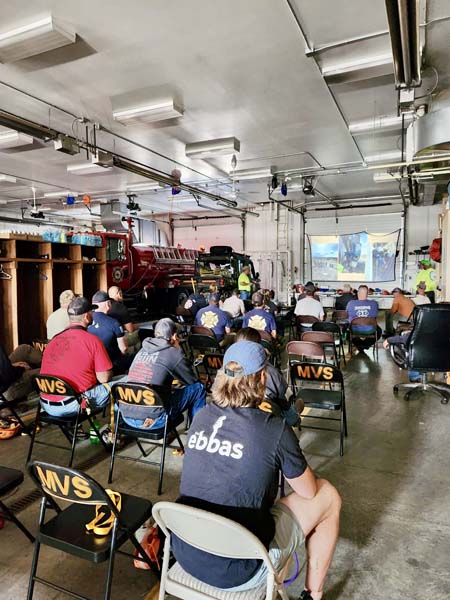
Emergency services providers from Meadows Valley and as far as Marsing and Grangeville gathered on Saturday, September 7 for a Rope Rescue Training at the Meadows Valley Fire Station. Grangeville Mountain Rescue Unit (GMRU)’s Brian Adams led the training along with colleagues John Finley and Ryan Robinson. Jeffrey Riechmann with Courageous Kids Climbing also supported. GMRU is an all volunteer unit and most of the almost 40 people in attendance are volunteers.
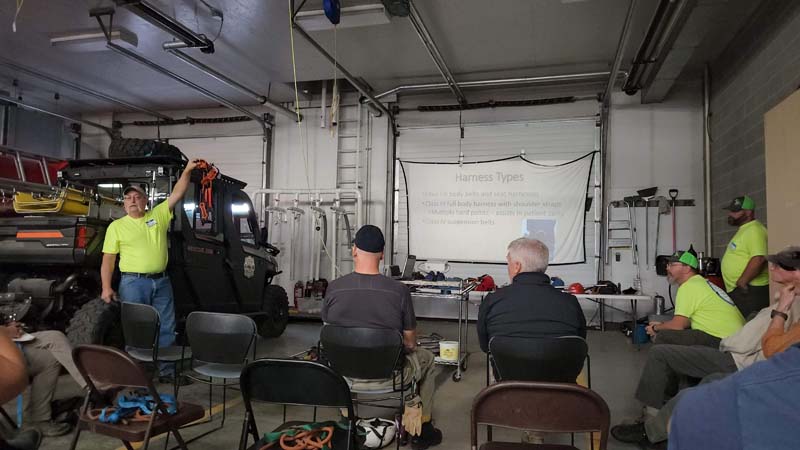
This is the second year having this training in New Meadows. The class is designed to teach emergency responders how to proceed at a scene with a vehicle over an embankment. Attendees were taught basic information on what safety concerns to look for, an understanding of hardware & software, how to reach patients in varying slope conditions, and ways to bring patients up to safety. Riechmann started off the training with a giving back opportunity with the upcoming Autism in the Wild event. He also provided detail on the Idaho Yellow Dot program that gives quickly accessible medical information to emergency responders when patients can not respond verbally.
Adams then led an engaging lesson offering real life scenarios through slideshow, story, and video. He encouraged students to always think about what resources they have available, how long it might take to access patients, ways to stabilize vehicles, and how to determine what gear to use to bring patients to the top. He also passed around various hardware and software including carabiners, pulleys, gibbs, anchor plates, descenders, ascenders and rope samples and harnesses.
Attendees learned about low, medium, and high slope angle responding. Teams should readily be able to respond to low and medium slope calls, but must consider that factors such as ice or loose surface can make medium slope considered high and may require more specialized techniques.
A large part of the morning training focused on ropes and knots. All dynamic and static ropes have a finite life. When taken care of perfectly, that may be around 10 years. Ropes may be weakened by use or damaged by water, dirt, loads, edges, chemicals, and also knots. Attendees were encouraged to inspect and log information about their ropes after every use.
Since knots can weaken a rope’s strength, a short list of knots are recommended for rescue situations. Knots need to be easily identified, verified, and untied. The figure 8 family of knots generally maintains the highest percentage of rope strength at about 80%. The Alpine Butterfly knot maintains 75% strength and can also be used to bypass a defect in a rope and maintain 52% of a damaged rope’s strength. About nine knots were taught and practiced during the class.
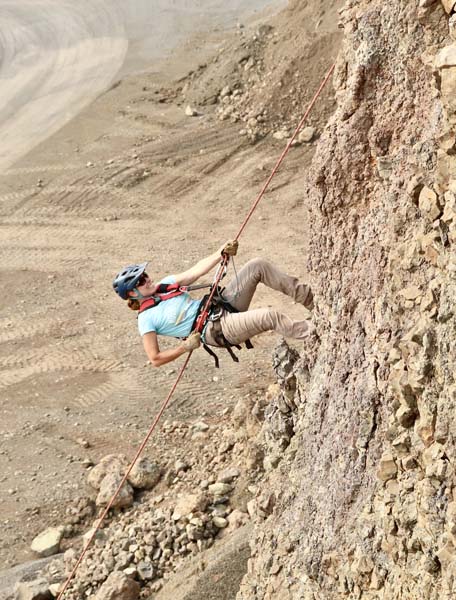
In the afternoon, the class moved to the local rock quarry for rappelling practice for off road rescues. Rope rescue class attendees were mostly from volunteer units. What an amazing offering of time and service for these providers to train on a Saturday to better assist the community and keep people safe!