


The ROC Supports Recovery in Council Through Connection
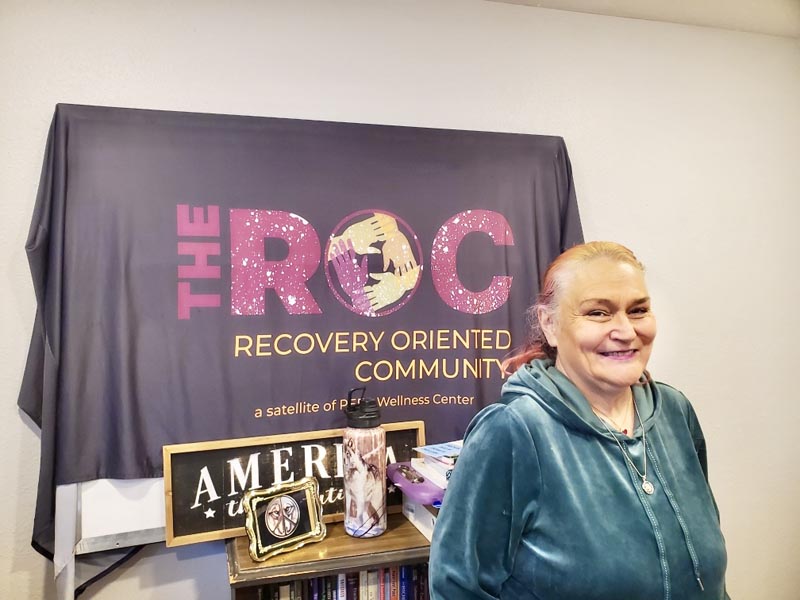
Substance abuse and mental health has touched nearly every family in America, and Idaho is no exception. In Council, Lorraine Bennett, in partnership with Monica Forbes and the Peer Wellness Center, aims to reduce the impact of substance and mental health disorders and support people in recovery putting a positive face on it and providing free, non clinical, peer based recovery services. Last year in Adams County, two separate groups came before the commissioners hoping for support for a recovery center. The Adams County Commissioners overwhelmingly chose to support a new satellite of the Peer Wellness Center, one of Idaho’s original recovery center’s based in Boise. This new satellite office is called The ROC in Council, and it is easy to see the many reasons even the commissioners found it worthy of support, beginning with the friendly and familiar face of Adams County resident Lorraine Bennett.
The ROC, which stands for Recovery Oriented Community, is located in downtown Council at 100 Illinois Ave., Suite #2.
Lorraine Bennett, a familiar name to many in the Council community, runs The ROC in Council. Bennett, who had been offering recovery support independently, partnered with Peer Wellness Center in 2025, and her office officially became a satellite of the larger wellness center.
Lorraine is passionate about helping the Council community, and after hearing her story one starts to understand why. Bennett is open about her background. The story isn’t pretty, but she feels it is important for others to know what she has been through, to give them hope and let people know that recovery is possible. Bennett grew up in Southern California and was gifted as a child, receiving multiple scholarships. She grew up in a Christian home, her family was Assembly of God, but there was alcohol around her at an early age and there was a high tolerance for it. She first tried marijuana when she was 12 years old, and started experimenting with other drugs from there. Her life quickly spiraled out of control. “I had made… my life pretty scary,” said Bennett. By the time she was 16, Bennett said she was living with a man who was 25 years older who she grew marijuana with and sold cocaine. “I was just oblivious to the dangers around me,” she said, “There was a lot of violence, there was a lot of drug activity, … and of course, I ran into trouble with the law.”
Through the years, she would try to get clean and sober. She did the 12 Steps, she did treatment centers, she kept going back to church. At 22 she received Jesus as her savior and thought that would change things. “I would do good for a while,” she said, “but I kept slipping out, slipping out.” Nothing would stick. She started having trouble with her liver.
In 2010, things came to a head when Bennett got into an argument with her boyfriend. They both had drugs in their systems, and she shot and killed him.
She said in the community they lived in people were of two minds, they either brushed it off as “tweakers being tweakers” or treated her almost like a hero because there was domestic violence involved. Neither were helpful, and Bennett thinks that neither are a justification for what happened. “Nobody’s life is worth taking,” said Bennett, “there was no justification behind it as far as I’m concerned.”
Bennett received a 15 year sentence with five years fixed and 10 indeterminate. She felt ashamed. Back home, she had become almost a poster child for recovery. “I felt like I let, not just myself, but the entire community down.” She was transferred from the Bonner County Jail and they stopped in Adams County.
Adams County was different then the other facilities Bennett had been at. They treated the inmates differently, more like real people. They asked her to work in the kitchen where she had real responsibilities and where the officers would come and listen to her talk about how she wanted to change her life. She started working with Pastor Geoff Cole from the Assembly of God Church and, with the help of her old pastor, he helped put her through bible college. She decided she wanted to be a minister when she got out and do faith based recovery services. Cole suggested that she move to Adams County when she was released, and the idea stuck with her.
She was passed up for parole the first time and was sent to Owyhee County Jail. Ryan Zollman, now Sheriff, and the undersheriff at the time came to pick her up and bring her back to Adams County. When she asked why, they told her they liked the way she worked in the kitchen and wanted her to keep working there. “All I ever got from the people here in Adams County was respect, it didn’t matter what I was, it was what I was doing,” said Bennett, “was I honest, was I trustworthy? Did I do a good job? And that set something off with me.”
In the end, she was in the Adams County Jail a total of 46 months, in increments. When she eventually did get out on parole, Bennett decided to come back to Adams County and do what she could to help others in this community. Pastor Geoff Cole and his wife let Bennett stay with them when she got out. “That was internal to my release,” said Bennett. “I’d like to say that when I killed my victim, I went “Oh, my life needs to change,” but it always needed to change, you see. When these people treated me like a human being, that’s what really got to me.”
Bennett started to do ministry in faith based recovery, as that is what worked for her, and had an office in a church. However when there was a change in the church administration she moved out of her office there, not seeing eye to eye with the new pastor, and started meeting with people at the library. Right away, she noticed that there were more people seeking her out. “I had more people visit me here and go to meetings at the library than they ever did while I was at the church,” said Bennett and she started to see where she was hitting a dead end with faith based recovery. “In my heart is for people to succeed,” said Bennett, “I can’t be single minded about this, my personal beliefs should not be involved in somebody else’s recovery unless they request that.”
Bennett was operating everything alone on what she was making. She found a new office in town and continued to see more people approaching her. She found herself continuing to serve more people, both from inside and outside the religious community. Then she reconnected with Monica Forbes, whom she first met while she was incarcerated, and Forbes thought she would be perfect for starting a new satellite office of the Peer Recovery Center in Council.
Monica Forbes describes herself as “a person in long term recovery,” which, for her, means she hasn’t used opiates since 2004. She helped to found the Peer Wellness Center in Boise and is now the CEO, as well as a Nationally Certified Peer Recovery Support Specialist, which is the same certification that Bennett is currently working towards.
When Peer Wellness was first funded by the state in 2015, they were generally given Region Four to provide services too, which didn’t include Adams County, but in order to effectively reach the whole region they started to look at the rural communities. They started a satellite office in McCall, The ROC-McCall, which developed partnerships with St. Luke’s in McCall, from there it was natural to reach out to the rest of St Luke’s service area, which is how they ended up bringing The ROC to Council.
“All of the recovery centers are funded by non tax dollars,” said Forbes. The original funding for Peer Wellness Center came from the Joint Millennium Fund, which manages the tobacco settlement that Idaho received many years ago. Idaho, unlike some states, still has the entire original principle of the settlement, according to Forbes, and has been investing it and using the interest and dividends to fund non-profits. More recently, opioid settlement funds have also started coming in, which is where the money Adams County pledged to The ROC came from. The opioid settlements are different from the tobacco settlements, because 80% of the funds are required to go directly back into remediation so agencies can’t sit and collect interest. “There’s no question that those funds can and should be used at the recovery community level,” said Forbes “they’re to help people that have been impacted by the opioid crisis.” Opioid settlement payments are expected to continue through fiscal year 2039.
The ROC uses the SAMHSA definition of recovery, “a process of change through which individuals improve their health and wellness, live a self-directed life, and strive to reach their full potential.” They don’t tell people what to do, but help them find the best path forward. Bennett and Forbes both stressed that there is no one right path to recovery. While Bennett is still passionate about faith based recovery, that is not the only service they offer “That’s what worked for me, and believe me I tried all the other things,” said Bennett. “All pathways to recovery. I tell you about mine, with Jesus, because it’s mine.”
The ROC offers a range of services, from meetings, to coaching, to harm reduction products like Narcan, Fentanyl and Xylazine test strips, and more, to transportation to detox and treatment centers. All their services are free. They don’t duplicate existing resources, but are happy to add new ones as requested.
A big part of what The ROC aims to do is help build healthy connections to the community. “The opposite of addiction is connection,” said Forbes, so they are trying to offer more clean and sober activities and events. “Recovery doesn’t happen in detox, it doesn’t happen in rehab…. It happens in the community,” said Forbes, and they will do “anything that we can do to promote healthy lifestyle connection in the community.” With that goal in mind, Bennett will begin hosting an Activity Night on Tuesday nights at the Council Valley Library for two hours each week from 7:00-9:00 p.m. “One of the biggest things that people have trouble with when they get out is knowing what to do, and they need to fill that gap with clean alternatives. It’s important.”
Bennett’s last day of parole is in March. After that, she was told the sheriff wanted to sit down with her and talk about what services she could bring to the jail. She also would like to see the ROC start working with youth, as that is one of the highest risk groups right now. Since Covid especially, there are more substance abuse and mental health issues across the board that they are still dealing with, especially in teens and adolescents. With the increased prevalence of drugs such as fentanyl, the stakes are higher than ever. “We’re not just selling the story that they sold to me when I was a teenager, that drugs are bad for you,” said Bennett, “we have to let those kids know… you can die because you don’t know what’s in it. … We can’t even just play around anymore.”
Rural areas can be resource poor when it comes to services, but slowly, that is changing, and organizations like The ROC in Council are helping to bring much needed support to small communities. Lorraine is so happy to be working with the ROC “I’m now part of a team,” she said, and is excited about future opportunities to serve her community. Currently, Bennett is dividing her time between the ROC in McCall and the ROC in Council, due to some recent staff shortages in McCall, but she is forever grateful to the Adams County community. Even Forbes noticed there was something special about this place. “Adams County, Council, is a very supportive community,” said Monica.
“We don’t choose to live with our chronic illnesses, but we do choose to be in recovery,” said Forbes, “so our job as a recovery center is to find those things that will support you in your choice to be in recovery.” Both Forbes and Bennett want people to know that recovery is possible and they are here to help along the way. “The hardest part about being in recovery is realizing and knowing that you’re not where you should be… I’m not where I should be right now,” said Bennett, looking back on her life, “but after working with Monica and the team in McCall and in Boise, I realize, I’m exactly where I’m supposed to be, I’m doing exactly what needs to be done, and if I hadn’t have done all this stuff, I wouldn’t be able to do my job.”