


What it Takes to Run a Rural EMS Operation
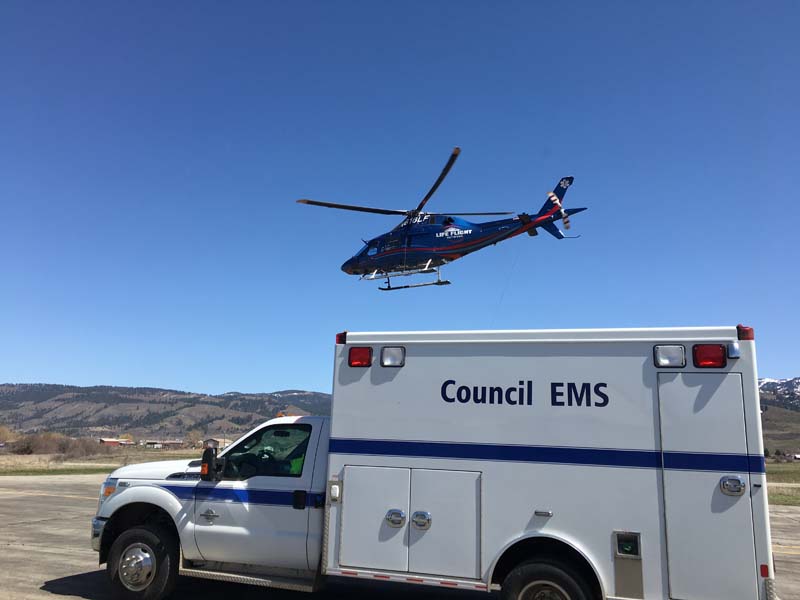
Ever wonder how much it costs if you have to ask the Council EMTs to come to your home? According to director Dan Huter, if they respond to your 911 call and take your vitals, and they decide you do not need to be transported to the McCall or Weiser Hospitals, there is no charge. And even if they think you do need to be transported, you can always refuse.
If you do need to be transported and have Medicare parts A and B or Medicaid, the cost of transport is covered.
Also, some health insurance policies will cover the cost of transport. You will have to review your policy.
If you do need to be transported, the cost is $12 per mile, but for people on limited incomes, monthly payments can be arranged.
The department receives approximately $100,00 per year from tax levies, and each year, they are allowed to ask for a three percent increase.
They have two four-wheel drive ambulances; one was purchased in 2016 and the other in 2023. They also have a chase rig, purchased in 2021, that can transport a patient if both ambulances are in use.
Huter said there have been times when even that is not enough. “Last summer we had one day when there were four calls in two hours,” he said.
But that is a rare occurrence, and there are no plans to purchase another ambulance. The vehicles were partially paid for by grants from the State of Idaho. The ambulance purchased in 2023 cost $220,000 and the state contributed $180,000.
When asked what happens if a patient needs Life Flight, Huter said that typically, a helicopter is sent. The longest they have had to wait for Life Flight to arrive is 40 minutes. He said that if a patient has severe burns and needs to be transported to Salt Lake City, they send a fixed wing plane. Typically, for a stroke or heart attack patient they send a helicopter.
The two EMTs who ride in back with the patient can contact Medical Control in either McCall or Weiser or Dr. Starr in Fruitland if they need assistance. And while EMTs cannot do what paramedics can, they can put in an I.V., give certain medications like Epinephrine, and perform CPR. They cannot intubate or give most medications.
Huter said that sometimes paramedics will meet the ambulance while on route, but sometimes they are too busy to respond. (Both Valley and Washington County Emergency Services use paramedics). Huter said they make a lot more money than EMTs, and that Adams County could not afford the cost. He said your entire staff must be either EMTs or Paramedics; you can’t just have one or two paramedics.
There are 11 EMTs, one of whom lives in Cambridge and another who lives in Crane Creek. There are two drivers, and yes, they must complete a driving course because ambulances are top heavy, and the drivers need to practice driving them, because they take curves differently than say a four-wheel drive truck would.
The EMTs attend class here in Council. The classes are 10 hours a week for about three or four months. Huter said they need to have at least 10 students to put on a class; oftentimes some of those students come from Cambridge or Midvale. They all must pass a national test given in the Boise area.
Three EMTs put in six hours at the office and are also on call for another six hours. They make $10 an hour. The other nine are on call for 12-hour shifts.
This past year, Council EMTs went on approximately 400 calls.
Huter has been an EMT here in Council for forty-five years and director for at least twenty-five of those years. He is currently working on getting the EMTs and drivers health insurance.