
In early 1886, Idaho Territory started institutionalizing it’s mentally ill citizens at the territory’s new asylum at the town of Blackfoot. Until this time, such people were sent to Salem, Oregon.
In those days, and into the earl 20th Century, newspaper reports of people being judged to be insane and put in institutions seemed common. This may have been due to the use of substances that were not known at the time to be toxic. Lead is a primary example. Lead was one of the principal ingredients in paint until fairly recent years. Even worse, tin cans, from which some people in isolated locations ate much of their food, were sealed with a solder that had an extremely high lead to content. Also, popular patent medicines of that day often contained cocaine or toxic and/or easily-misused ingredients.
In the 1880s, treatment of mental issues was often harsh, unscientific, and rooted in misunderstanding, though some reform efforts were underway. Mental illness was often seen as a moral failing or spiritual weakness,. Psychiatry was in it’s infancy, and many treatments were based on trial and error, superstition, or outdated theories like “humoral imbalance” or demonic possession.
Many patients endured overcrowded conditions, physical restraints, and rudimentary therapies that would be considered inhumane today. Hydrotherapy (cold or warm baths) was believed to calm agitation or stimulate lethargic patients. Isolation and seclusion rooms were used to manage disruptive behavior. Electrotherapy and mechanical devices (like spinning chairs or tranquilizing chairs) were sometimes employed, often with little understanding of their effects.
Other notable social characteristics of that era was open racial and religious hatred. Newspaper editorials condemning Chinese immigrants as filthy and degenerate reflected a commonly held pubic opinion. Anti-Mormon articles appeared frequently in newspapers.
Black people were almost always looked upon as inferior. Local black men were pretty much always known by the “N word” in front of their first name, e.g., “N____ Bill” or “N___ Jim” even in newspapers. In fact, as recently as the early 1960s, on Forest Service maps, there were two small tributaries of Indian Creek, not too far south of Cuprum, with exactly those names: “N____ Bill Creek” and “N___ Jim Creek.” (Of course the full word was used.) At some point, those creek names on Forest Service maps changed to “Negro Bill Creek,” and “Negro Jim Creek.” Today they are labeled “Bill Gulch” and “Jim Gulch.”
By 1886, a semi-weekly stage ran between Indian Valley and Meadows. From there, mail was carried to Warren on pack horses. C.C. McCoy now held the mail route contract.
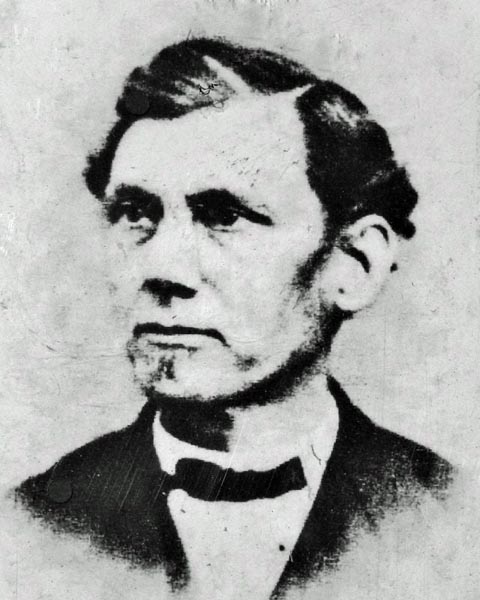
Frederick Wilkie was mentioned frequently in the Weiser City Leader newspaper in 1885 and ‘86. Being only about 20 years after the Civil War, every adult had a clear memory of that bloody conflict, in which Wilkie had been an officer in the Union Army. Even though many of the settlers in this area had come from Southern states, “Major Wilkie” as he was often called, seemed to be well-liked.
Wilkie, his wife, Sarah, and their four sons established a home where the Council-Cuprum Road turns up Mill Creek from Hornet Creek in 1882. He bought a sawmill from Amos Hitt (after whom Hitt Mt. is named) in 1885. I believe it was powered by a water wheel, and a depression at the site is still visible. I assume Mill Creek was so named because of this mill and others that the Wilkie family would operate in that vicinity in coming years.
In the spring of 1886, Frederick Wilkie was appointed justice of the peace, replacing Henry Childs who resigned. Wilkie was very active in the local Republican Party, and that November he was elected County Commissioner from the 3rd District.
Also that November, Levi Allen (the man who discovered copper in what would become the Seven Devils Mining District in 1862) started a new sawmill at Indian Valley. This seems to have been the first such mill in that valley.
Near the end of 1886, Levi Allen, along with Isaac I. Lewis and Samuel T. Hauser (governor of Montana Territory) sold mining interests to Albert Kleinschmidt for $80,000. Kleinschmidt may have been investing here since the previous year (1885), or this may have been his first investment. To put that dollar amount into today’s dollar value, Kleinschmidt spent the 2025 equivalent of $2,757,600.
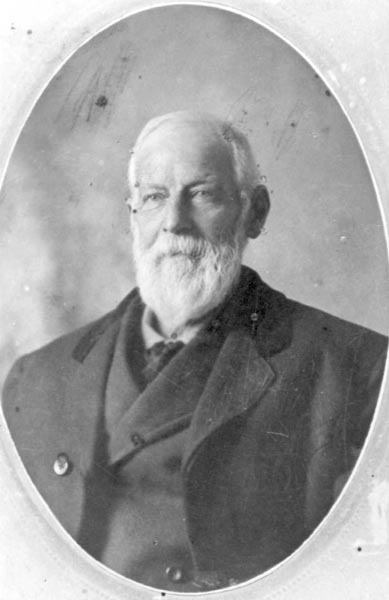
Isaac Ives Lewis (1825-1903) is an interesting character. Originally from Minnesota, he had been a justice of the peace and was elected to the state’s House of Representatives in 1867. He wound up in Montana where he borrowed a great deal of money to purchase mining claims‚ ventures in which he lost a lot of money but eventually made it back, and more, becoming quite wealthy.
In her history of the Seven Devils Mining District, Winifred Lindsay speculated that Lewis may have accompanied Levi Allen on his initial exploration and discovery of copper in the district. (I doubt this.) At any rate, Lewis was an early partner of Allen’s, and, as I noted in my Oct. 8 column, journeyed with Allen to the Peacock claim in 1877.
Lewis invested in mines in the Sun Valley area and established a town he named “Leadville,” but the name was later changed to “Ketchum.”
Just a mile or two back toward Council, the Peck family lived in the big white house that still stands at 2730 Council Cuprum Road. On October 9, 1887 their two boys, ages about 12 and 16, were hunting in the head waters of Hornet Creek. They came across a bear cub and killed it. Farther on, they saw a large, male, cinnamon-colored, black bear. They shot and missed, and the bear began to charge them. The older boy stood his ground and shot, breaking the bear’s hind leg. The bear continued to charge, and the boy clubbed the him over the head with his rifle. The bear bit the boy’s arm and leg before the younger brother ran up and shot the bear in the head, killing it. Evidently the older boy’s injuries weren’t serious. The boys packed the smaller bear home, then returned with a wagon for the big one.
The story appeared in the Weiser newspaper, and was submitted by James Smith of Hornet Creek. No comment was made by the paper about the boys shooting a bear cub. People in those days had a different sense of their relationship to wildlife than most of us do now. Nature was still very much an obstacle to overcome - an adversary to be subdued. I remember reading a story in an old Council newspaper (I don’t recall from what date) about a local man who shot a very unusual bird just to see what it was.
I now have an hour and a half presentation about the Seven Devils Mining District on YouTube.com. Just type my name into the search bar there, and all my videos will show up.
100 years ago
November 19, 1925
Howard Hunsaker and H. E. Copenhaver purchased the Ware & Co. store. The new proprietors operated a filling station here last summer until a fire destroyed their building.
One of the largest stock shipments we have noted in many days was sent out last Friday. Eleven train carloads were started from this point - 10 cars of cattle and one car of hogs. The entire bunch were shipped to Weiser for winter feeding.
Crane Creek - “The mail carrier has abandoned his car and is now carrying the mail by team. Recent rain has made the roads nearly impassable for autos.”
Hog Creek - “A number of Cambridge nimrods were on the Creek hunting Chinese pheasants Sunday.”
Advertisement for radios at the Cambridge garage: Atwater Kent 5 - tube = $130. Grebe Synchrophase = $215. (These prices would be the equivalent of $2,412 and $3,990 in 2025)
75 years ago
November 16, 1950
“If the proposed Hells Canyon dam is not approved by Congress, Idaho Power company may build five smaller dams between here and the Hells Canyon site. They would be located at Bayhorse, Sturgill, Brownlee, Oxbow and Hells Canyon, according to present planning. The power company has had an application to go ahead with the construction before the federal power commission since 1947, but that the FPC is withholding action pending a congressional decision on the proposed Hells Canyon dam.”
49 years ago
November 18, 1976
Died: Holden P. Clement, 90, of Council. He and his wife, Lillian, moved to Council from the Ontario area in 1934.
Died at Enterprise, Oregon: John D. Jones, 71, formerly of Cambridge.
25 years ago
November 23, 2000
This issue contained an article titled “Memories of Old Salubria” by the late Margaret Hannnn Peterson.
Died: Billie Dean “Santa” Fugate, 64, Cambridge.
Died: William Ira Melcher, 77, Fruitland.