
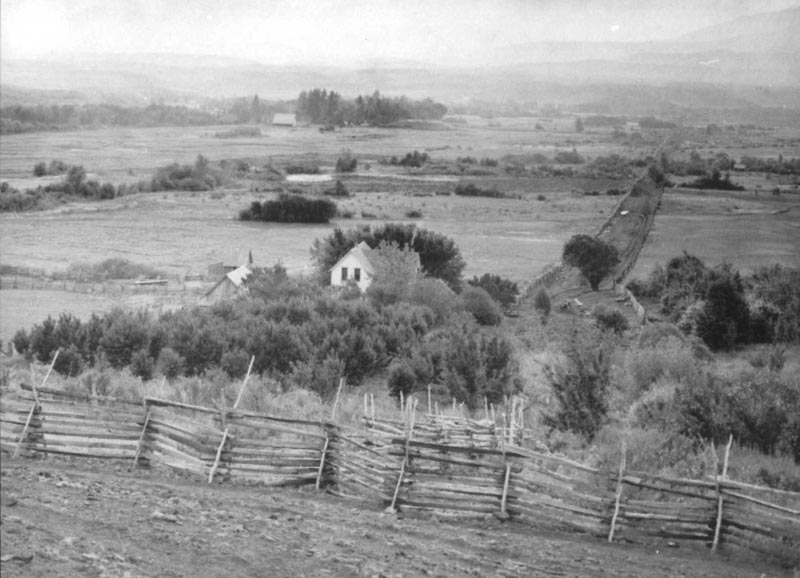
By mid-December of 1889 the region may already have had more snow than all the previous winter. And it just kept coming. By January 1890 there was three feet of snow in Long Valley, and people were happy to see it, even though it was accompanied by 20 below zero temperatures. The precipitation was very inconsistent. There was four feet of snow in Middle Valley (Midvale), six inches in Weiser, and three feet at Council. Thirty feet was reported at Warren.
By the end of January, mail carriers were having trouble getting through the canyon between Council Valley and Meadows. Ice jams started forming all up and down the Weiser and Snake Rivers, causing serious flooding. Reports of drowned livestock, mud and rock slides, bridges damaged or washed away and railroad damage filled area newspapers. Transportation in some places came to a standstill.
By early February, a report from Long Valley said, “We have had a very severe winter so far. Snow is twenty-eight inches deep. We have had very high winds and the snow is badly drifted, making it hard to keep the roads open. Hay is getting very scarce, and it looks as though the loss of stock will be severe. Last winter was so mild and short that the people did not prepare for a winter like we are having.”
The Council corespondent for the Weiser Leader wrote: “Our winter has been a remarkable one. Snow fell December 8th, and kept falling until it was from three to four feet deep on the first of February.”
In February it warmed up and started raining all over the region. This caused more flooding. Along Hornet Creek about 88 head of cattle and horses drowned. All ten of the brand new bridges across the Weiser River between Council Valley and Price Valley were obliterated.
On the positive side, the rain melted the snow to such an extent that some stock was put out to graze during the first week in February.”
In Long Valley, bare south-facing hillsides gave stockmen hope that their animals would soon be eating grass and not depend on the last scraps of hay that remained. Some horses had already died, not from starvation but reportedly from exhaustion from pulling loads through insufferable snow depths. Cattle, however, had started to starve. Some people cut willows along the creeks and fed them to cattle. Others reportedly resorted to emptying straw mattresses for feed.
Some ranchers near Roseberry organized to get their cattle to a better location. They somehow made a four-mile-long trench through four to seven-foot-deep snow, reportedly with shovels, and drove their cattle through it to where the fires had burned the previous summer and there was green grass sprouting. Sleds loaded with hay brought enough nourishment to keep the cattle going. By the time the ranchers reached the grassy area, a storm dropped four inches of snow. The ranchers decided that since the cattle were going to die anyway, they would give them the last of the hay that was left. By noon, the sun came out, and by nightfall, bare ground and grass were visible. The cattle were saved.
By this time, human food supplies had also reached critical lows because the roads had been impassible – first because of snow, and then from deep mud and flooding. Nobody starved, but the experience soured a number of settlers in Long Valley; they left to find a less hostile climate.
George Gould had been thinking about settling in Long Valley, but that winter persuaded him to explore other options. In April of 1890 he bought the William Linder place at the east end of Cottonwood Lane south of Council. He adopted the “90” brand for his livestock in honor of the year he began his ranching career.
In May 1890 the Weiser Leader reported that 20 teams were enroute from Montana “to build a road from the Seven Devils camp to the steamboat landing on the Snake river.” Albert Kleinschmidt had hired them to build a 22-mile road that dropped 5,000 feet in elevation from the Peacock Mine to the Snake. All that summer crews with teams, picks, shovels and blasting powder scratched out this road across some very rugged, steep mountainsides.
In June, a lantern fell and broke at a saloon in the part of Weiser that had not moved to the railroad depot. The resulting fire destroyed two blocks of the old town – most of the business section. This set the stage for the nearly complete abandonment of the old Weiser and the growth at the current site of the town, at the depot.
That summer a baseball team was established at Council. This was likely the first such team, as there was no actual town yet – just John Peters’ store and a school north of the present town. But that would change very soon.
Meanwhile, Weiser was the main town from which supplies were freighted into the Seven Devils Mining District. And some Weiser businesses either moved or expanded to that location. The Weiser Leader noted: “Several of our townsmen are doing the Seven Devils. Stores, groceries, gin shops, town sites and mill sites are now the order of the day.”
On July 4, 1890 Idaho became the 43rd state.
100 years ago
December 17, 1925
A girl was born to Mr. and Mrs. Pete Gladhart December 10.
“Folks who have a radio long usually get so absorbed in the things it brings that they are classified as a ‘Radio Bugs’.”
A boy was born December 11 at the home of Mr. and Mrs. Marvin Imler of Mesa. (Under the Indian Valley section in this issue, the birth date was announced as December 12.)
Died: John Schwenkfelder. He was born in Switzerland in 1829 and came to America in 1882, moving to Salubria Valley in 1888.
75 years ago
December 14, 1950
“Mr. and Mrs. Jess Maddox have moved here from Tacoma, Washington to take over management of Hunter’s Inn. The Maddoxes have owned the Inn for a number of years but until now have leased it to other operators.” Mr. and Mrs. Von Madsen have been operating the Inn.
49 years ago
December 16, 1976
Died: Wilbert (Bill) Maddox, 84, Cambridge. He farmed and ranched near Rush Creek for 20 years, and for 9 years he and his wife owned and managed the Hunters Inn at Cambridge.
Died: Robert D. Van Komen, 42 of Star, formerly of Cambridge.
Died: Lillian Clement, 87, Council, at an Indian Valley rest home.
25 years ago
December 14, 2000
“Effective January 1, 2001, drivers under the age of 17 must pass more stringent requirements to qualify for a driver’s license. The law raises the age to enter drivers education from 14 years to 14 years, six months, and establishes a four-month probationary period after formal drivers training that must include at least 50 hours of supervised driving practice with a licensed driver age 21 or older.”
The new Cambridge Middle/High School will hold an open house December 18.