
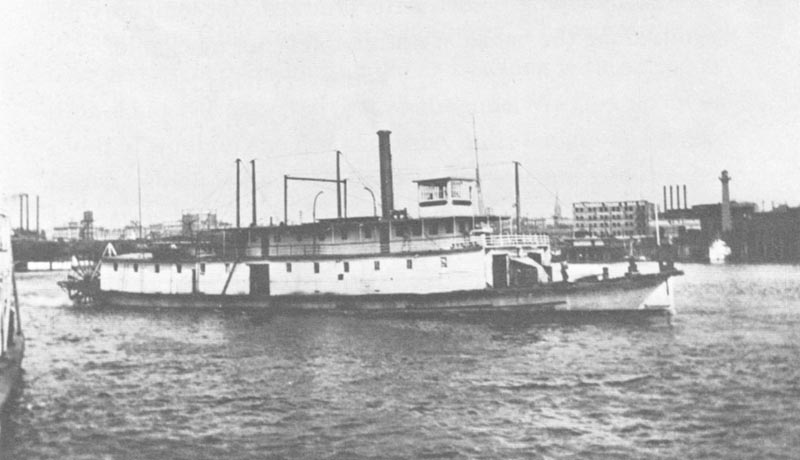
Weiser Signal, 10-8-1891: “The steamer Norma, built in 1890 to ply upon the Snake river between Huntington bridge and the Seven Devils mining country, was sold at Sheriff’s Sale on Saturday last to Captain W.P. Gray, of Portland, for $4,000. Jacob Kamm will in all probability get the boat, as it is generally understood that Captain Gray bought it with Kamm’s money. As is usual in such cases somebody gets left, $8,000, of executions and attachments being entirely worthless. Amongst those fortunate enough to secure payment of their claims is J.T. Fyfer, $1000 and C.F. Kent, the ship’s carpenter, about $600. What will become of the Norma we do not know positively, but from indications we believe she will be taken down the Snake into the Columbia with next year’s rise of water.”
The hair-raising tale of Captain Gray taking the Norma to Lewiston, through Hells Canyon, is a story for another day.
The October 9, 1891 Idaho Citizen reported that Hugh Curren had made a “rich strike in the Seven Devils north of Rapid River.” I assume Curren Mountain is named after him.
In October, Isaac and Lucy McMahan established a store at a place Lucy named “Alpine” at Indian Valley. The location and store still go by that name.
Weiser Signal, 11-5-1891:“As was spoken of in this paper a while back there was a post office at Helena and bids were advertised for the carrying of mail from Dale to that place. This route would supply Crooked river and Lick creek. Alas for the residents of that section! A man from Oregon absconded with the P.O. and when the bids were sent in there was no one to receive them. The postal department fell in a dead faint and has not recovered yet.”
Remember those 10 brand new bridges that washed out on the Weiser River in the canyon north of Council Valley in the legendary winter of 1889 - ‘90? Near the end of 1891, the County finally got around to advertising bids to replace them. A section or two of new or rebuilt road was included, with the specification that the road was to be six feet wide. Now that’s a narrow road!
The rough nature of wagon roads of that day was hard on vehicles, sometime causing a catastrophic failure of wheels, axles, etc. In November of 1891 the stage coming north from Midvale was coming down the steep hill into Salubria Valley when the front axle on the lower side of the coach snapped in two near the wheel. The front corner of the coach slammed to the ground, causing the vehicle to roll violently. There was no mention in the Signal as to how this affected the 4 or 6-horse team that was anchored to his disaster, but the stage driver, John Lympus, was thrown down the incline and landed on his back. The coach came slamming down the hill and landed right on top of him. His grave is in the Salubria Cemetery. There was no mention of passengers.
By the end of 1891 the State Wagon Road from Payette Lake to Warren had been completed. Prior to that time, all supplies, and some mail, for the mining camp had been coming to Warren by way of Grangeville. The new road did not please Aaron Parker, editor of the Idaho Free Press at Grangeville. He claimed “The road between Camas Prairie and Warrens can be traveled for 2 months more each year than the road to Warrens from Salmon Meadows.”
Parker also pointed out a stretch of the southern route that was a horror in winter. He said a 15-mile long canyon between the upper and lower Payette lakes “where the sun is not visible for four months in the year, and where the snow accumulates to a depth of fourteen feet each winter. There are cottonwood trees on the route of that road with the initials of the mail carriers cut deep in the bark at a height of 18 feet from the ground–cut by the mail carriers as they dismounted and stood on the snow a few years ago when there was a mail service between Salmon Meadows and Warrens.”
1892
In January a mention was made in the Signal of a mail route between Indian Valley and “Biggerstaff’s.” Tolbert Biggerstaff maintained a stage station at the summit of Fort Hall Hill.
Weiser Signal, 2-4-1892: “Salubria is talking seriously of establishing an electric light plant about a half a mile from town at Mr. Cuddy’s mill. The inhabitants claim that such a light used in and about town would be of less cost than coal oil, taking the future into consideration regarding the expense of starting it.”
Coal oil or kerosene lamps were the main source of lighting in those days, but electric lights had appeared in cities. Everyone dreamed of having electric lights, partly because they were brighter and much easier to use, but also because fires caused by lighting with a flame was a constant threat. It was common for whole sections of a town to go up in flames, as happened more than once in Council.
Margaret Hannon Peterson wrote about the street lamps in Salubria: “The few streetlights in town burned kerosene and had to be protected from wind and rain storms by a hood cover. The light that shone through the isin-glass was not very bright, but it was better than no light at all. These lamps were on posts about 7 feet high. There was one at the corner of dad’s saloon.”
Her reference to isin-glass (actually isinglass) referred to a semi-clear material made from fish swim bladders, but that material was not usually used for lamps. What she called isin-glass was almost certainly actually thin sheets of mica. It was commonly used for lamps because it was less breakable than glass, and many fires were caused by a glass-enclosed lantern breaking.
Mrs. Peterson also said of Salubria: “The only fire protection of the town provided was the bucket brigade. When a fire started, every man grabbed a bucket and ran to the nearest well. As fast as the buckets were filled they were carried to the fire and the water was thrown on the blaze. The building in which the fire started was seldom saved, but occasionally buildings nearby could be prevented from also catching fire.”
100 years ago
January 28, 1926
Died: Mrs. Fred Potter. She grew up in this area, having lived on Crane Creek with her parents, Mr. and Mrs. L. McFadden, and after marriage lived in Midvale until a few years ago when she and her husband moved to Council Valley. Interment in the Weiser Cemetery.
“A large team of mares, belonging to Nelson Linder, broke through the ice on the river Monday. When attempting to leave the river with a load of ice, the ice gave way, overturning the sled and load of ice into the water. Only one of the horses went down part way and was soon gotten out, but the other went down in about 6 feet of water, and it was with much difficulty that the men succeeded in getting a rope around the mare’s body and dragged her out.”
Ad: Winter Carnival & Dog Races – McCall, Idaho, February 12 and 13.
75 years ago
January 25, 1951
Bob Wininger is the ship’s barber on the U. S. S. George K. McKenzie at Korea.
A girl was born to Mr. and Mrs. Don Keckler of Mesa January 22.
A son was born January 13 to Mr. and Mrs. Kenneth Downey.
49 years ago
January 27, 1977
Died: Frances A. Wilson, 76, Cambridge. She married Harold Wilson in 1925 and in 1929 they made their home at Cow Creek Ranch where they lived until they sold the place in 1959.
25 years ago
January 18, 2001
The population of mountain lions in our area is increasing.
Idaho is running out of telephone numbers for the 208 area code.