
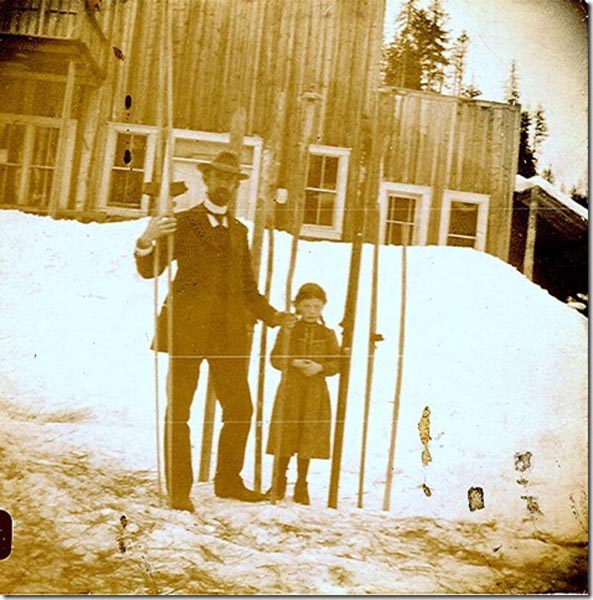
In case the heading “Part 2” is confusing, I started 1892 in last week’s column, along with the end of 1891.
In 1892 the U.S. opened its new immigration inspection station at Ellis Island, under the Statue of Liberty. The General Electric Company (GE) was created through a merger of Edison General Electric and Thomson‑Houston. Charles Duryea claimed to have driven the first American gasoline‑ powered automobile in Springfield, Massachusetts. James Naismith published the first official rules of basketball. John Muir organized the Sierra Club.
Labor issues made headlines as the country rapidly industrialized and the Gilded Age continued to divide society into the very rich and very poor. Northern Idaho labor tension resulted in what became known as the Coeur d’Alene labor war, with much violence yet to come.
Prices for agricultural crops declined, unemployment rose and some businesses began to close.
All these factors foreshadowed an economic crisis that would come the next year.
Levi Allen’s stepson, Charley Allen, started off the year with a bang – quite literally. In the Seven Devils Mining District, he put a dynamite charge in the bottom of a 110 foot shaft at the “Lobo” mine. It was about 6:00 p.m., so he put an extra big charge to have plenty of work the next day. He lit the fuse and started the long climb up the wooden ladders. At about the 65 foot level, he slipped when changing ladders and fell headfirst. At a point 8 or 10 feet above the dynamite he landed on a ledge. The Idaho Citizen said he: “struck bedrock on his side and within 2 feet of a double charge of giant powder which went off a minute later. Charley says as he lay there breathing like a steam boat coming upstream that he thought sure his time had come.” After the blast, his two companions “carefully lowered the ore bucket and then cautiously descended into the impenetrable darkness, fully expecting to find the lifeless and mutilated body of their companion, but were surprised to find him sitting comfortably in one corner of the shaft smoking a corn cob pipe.” He only suffered scratches and bruises, none of which were said to be serious. Nobody reported how it affected his hearing.
The February25, 1892 Signal mentioned “...the Farmers’ ditch in Council valley, taking water from the Weiser river about 6 miles from Council Valley post office and bringing it out upon the east side. The length of this ditch is 6 miles and its bottom width 4 feet. It is owned and is being completed by private parties, each share entitling the owner to 59 miner’s inches.” This sounds somewhat like the East Fork Ditch, but it starts more than six miles from Council.
The Signal also said: “Further down, in Indian valley, is the Indian Valley and Gray Creek ditch, taking water from the Little Weiser river and carrying it in a northwesterly direction. It is 7 miles long, 5 feet wide, cost $1,350,, and is owned by a corporation, each share entitling the owner to 100 miner’s inches of water.”
Weiser Signal, 7-7-1892: “Dr. W.M. Brown lately from Omaha has brought the practice, office fixture &c, of Dr. E.P. Howard, and no doubt (coming well recommended as he is) will do an excellent business and we hope will be very successful.”
Dr. William Brown would become a leading citizen of Salubria, Cuprum, Decorah, Landore, Council and Starkey (in that order). He and his wife, Emma, were relatively newly married, having wed on Oct. 1, 1889 in Nebraska. Earlier that year, Emma had given birth to their daughter, Winifred. Before long, they had another daughter, Mildred.
Dr. Brown was a tall, slender man and wore wire-rimmed glasses. The 32-year-old doctor quickly established a reputation as a brilliant diagnostician. He was the 42nd doctor licensed in the State of Idaho.
Meanwhile, in Northern Idaho, Labor tensions at the Bunker Hill & Sullivan and Gem mines reached a flash point. Union miners begin stockpiling weapons in response to armed guards at the mines. Mine owners refused to negotiate. Shots were fired in the Gem Mine on June 6, wounding several men.
In July, miners seized an ore mill near the Gem Mine and dynamited it. Gun battles between miners and company guards killed several men on both sides. Governor Wiley declared martial law and federal troops were brought in. Hundreds of miners were arrested without warrants or legal process and put in prison camps called “bull pens.”
In 1892 unions were legal, but almost everything they did could be, and often was, criminalized. Members had almost no meaningful legal protections, and the law tilted heavily toward mine owners. Idaho was only two years into statehood, and its legal framework reflected the national Gilded Age pattern. Courts treated unions as potential criminal conspiracies. The state sided with employers during labor disputes. Federal troops were routinely used to break strikes, often resulting in violence and death.
The violence in Northern Idaho became known as the “Coeur d’Alene Labor War” and made national news. There was much more violence yet to come – and a murder that would create a national sensation as “The Trial of the Century.”
100 years ago
February 4, 1926
“Ice harvest has been going steadily forward as fast as possible since workmen started cutting and hauling the last of the week. Practically all the larger houses of the town have been filled. It is of good quality, though hardly as thick as some years.”
A boxing contest was held at the Community Hall Monday night. “Two preliminaries between Little Dick Armacost and Jimmy Reed, and Lester Reed and Willis Allison, were fast and interesting.”
T. S. Youngblood has been remodeling his grocery store building, which is occupied by the S. M. & G. Company. The refrigerator was taken entirely out and a new one built in at the rear of the building and a small room partitioned off for a kitchen. The partition which separated the two main rooms was taken out, making the meat market and grocery into one large commodious room.
75 years ago
February 1, 1951
A new mining operation will open up mining ground near the Pine Grove school house. The operator said: “We will take out magnetic iron and hematite with the strip mine process, using air hammers, bulldozers, shovel and trucks to clean out the ore body as we go down.”
An electrical fire damaged the Cambridge Hotel Friday morning.
49 years ago
February 3, 1977
Died: Harold J. Coriell, 68, Indian Valley. He was born in 1908 at Indian Valley and grew up there.
Died: Floyd Myers, 80, of Wenatchee, Washington, formerly of Salubria.
25 years ago
January 25, 2001
“The barn on the Wilson/McCoy property in Cambridge, built around 1903, has been completely rebuilt. It is the same shape as the original barn, only on a lot smaller scale.