
As the 1800s came to a close, Americans were increasingly angry about political corruption, labor exploitation and wealth concentrated into the hands of a very few. In early 1899 labor tensions in the mines of Northern Idaho came to a head. Mine owners took extreme actions against unions, which enraged miners who wanted better working conditions. Feeling their backs were against the wall, some miners turned violent.
This was an interesting time. Alfred Nobel had invented dynamite in 1867, and it had become a very useful tool in all kinds of excavation. It also provided a powerful tool for people who felt powerless. It was inexpensive and available in every mining camp, and it was used as a coercive tactic by members of miner’s unions often enough that anti-union forces claimed dynamite was “the miners’ favorite bargaining tool.” One of the most dramatic instances of miners using dynamite – and one that made national news – was in April of 1899 when they blew up the ore concentrator at the Bunker Hill & Sullivan mine at Wardner, Idaho, just south of Kellogg.
This explosion, and increasing violence, motivated Governor Frank Stuenenberg to call in federal troops. Union members, and anyone suspected of being a union member or union advocate, were arrested without due process and imprisoned in prison camps called “bullpens” for weeks or months. They were eventually released, but miners’ resentment about this lasted for years. So much so that dynamite was used to murder former governor Frank Stuenenberg almost 6 years later.
Meanwhile, the first known use of the word “automobile” appeared in The New York Times on January 3.
Carlos Boyd started a newspaper at Cuprum called the “Seven Devils Standard.” (Its office would later be in Landore.) It’s first issue came out in early February.
After years of rumor, speculation and false claims about a railroad being built north from the Union Pacific’s Oregon Short Line, in February the Pacific & Idaho Northern Railway Company was established and announced plans to build a line to the Seven Devils. The company was secretive about the exact route, but it was finally determined that it would leave the OSL from Weiser and generally follow the Weiser River.
People at Salubria heard rumors that the rails might miss their town, which would spell its doom. The Salubria Citizen editor said, ““Every day the indications become stronger that the railroad will go on the other side of the river. Which shall we do? Shall we have a town or shall we move?” By mid summer the devastating news came; the rails would be laid to a new town called “Cambridge” instead of Salubria.
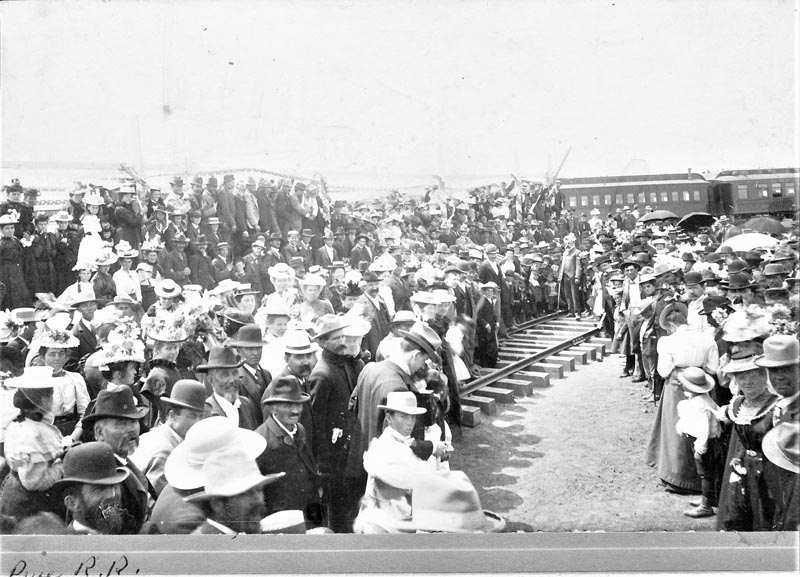
In April, about 100 Japanese railroad workers arrived at Weiser. Railroad contractors often hired large groups of a particular ethic group to work on a new line. Some grade was built, and on May 19 the first rails were laid at Weiser. The first spike was made of Seven Devils copper and was driven during a big ceremony at which several prominent citizens spoke.
In the mountains around Council, loggers and sawmills got busy providing railroad ties. The P&IN Company set up a sawmill on Goodrich Creek.
Telephones began to be installed at Weiser, and construction of a line toward the Seven Devils was planned.
In May, a law prohibiting gambling in Idaho went into effect.
John Peters and Frank Raestle established a new meat market in the booming town of Council. The Citizen said the town had a population of 150 and featured “three general merchandise stores, and two hotels, four saloons, blacksmith shop, meat market, etc. The principle industries of the valley are farming, stock raising, mining, lumbering.” It said about 250 people lived in the Meadows area.
A corespondent for the Statesman newspaper wrote an article about his journey through the upper country and said of Council, “Eight new buildings were in process of construction and a large number of people are going in.” Referring to the plans of the railroad, he said a branch would divert from the main line at Price Valley to reach the Peacock Mine or Helena in the Seven Devils.
The correspondent wrote about plans for when the tracks reached Meadows Valley: “The new town of Meadows will be located at or near McGlinchey Springs on the west side of the Valley and an option has been granted the railroad for land at that point on which to build. Leaving Meadows the road passes down the little Salmon River. The railroad survey having been extended to a point below the mouth of Boulder Creek, and a splendid grade secured. The falls of the Little Salmon, five in number and all within a stretch of a mile and a half, are most beautiful. The larger fall has an almost perpendicular drop of 30 feet. Salmon come up this river as far as the high falls, which they cannot scale. At the bottom of the high fall, the river has made a curious freak of nature having cut the rock out in the shape of a gigantic bath tub about 40 by 50 feet in extent with a slide running down it, similar to a toboggan slide. This phenomenon has been named the ‘Devils Bath Tub’.”
100 years ago
June 10, 1926
The Chautauqua starts Friday and will last four days.
The community tennis court is being used by local players. “It will be remembered that this court was purchased and equipped by the members of the cast of the home talent play, ‘And Home Came Ted,’ which proved so popular at its three presentations in this section.”
75 years ago
June 7, 1951
“The Midvale Farm Bureau, which was organized in 1948 by Bruce Bartlet, has attracted much attention with project which was organized by the Midvale Bureau – that of marking country roads in the area so that farms are easily located by merely watching signs at intersections. Names of all farmers living on a road out of Midvale are posted at the first intersection.”
49 years ago
June 9, 1977
“The Thread Shed” is now doing business in the former Cambridge Electric building, which has been completely remodeled by Kermit Wiggins, the new owner. Mr. Wiggins has also purchased the former Cambridge Barbershop next to the thread shed, and that building is being torn down.
25 years ago
May 31, 2001
Died: Sue Davison, 55, Indian Valley.
“Adams County Sheriff deputies issued citations to 165 out of county youths last weekend at a field near Pole Creek. The citations were for minors in possession of alcohol, and for minors in possession of controlled substances. Sixty-nine of the kids were arrested Friday night and the rest were arrested at various times Saturday morning as they returned to their cars from their hiding places in the woods.”