
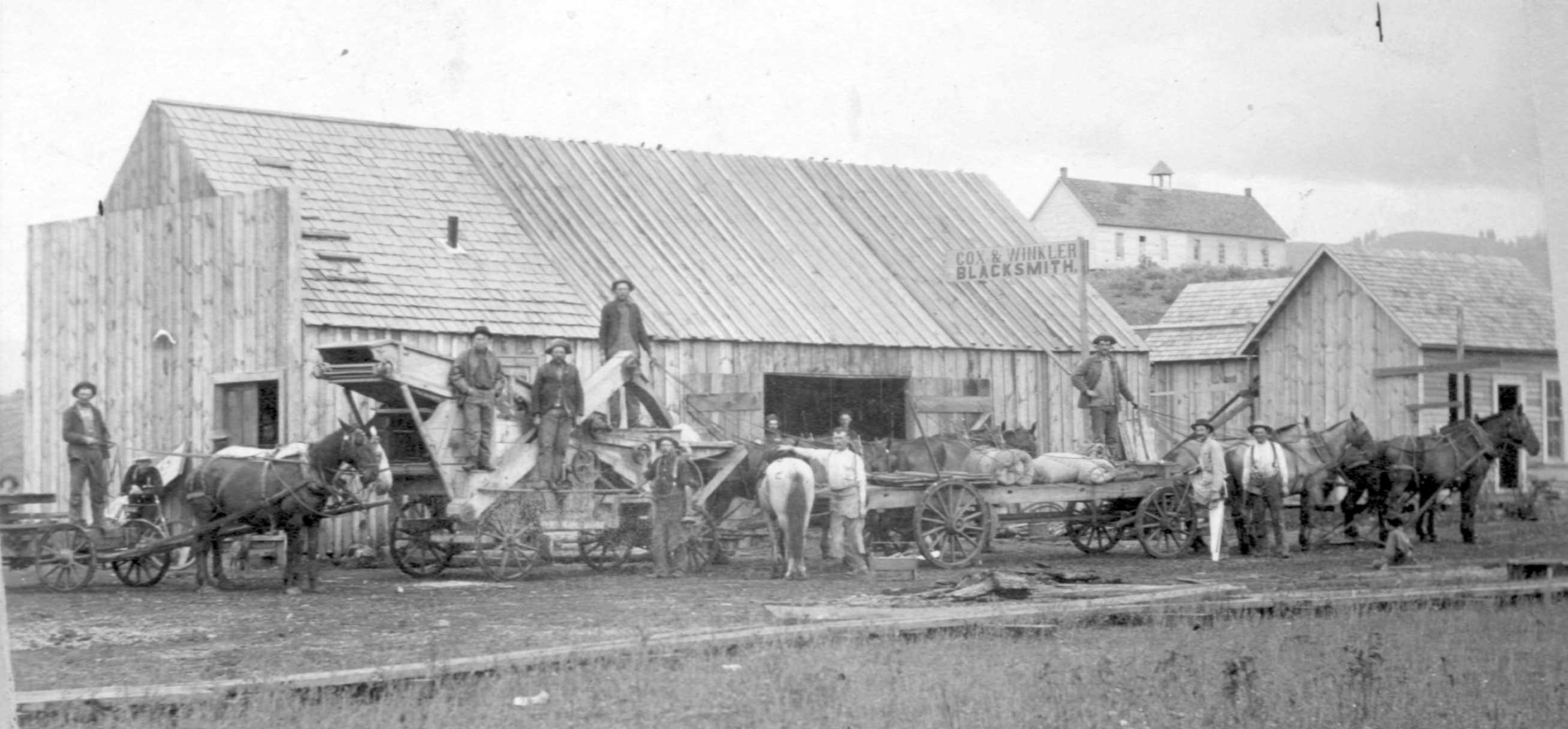
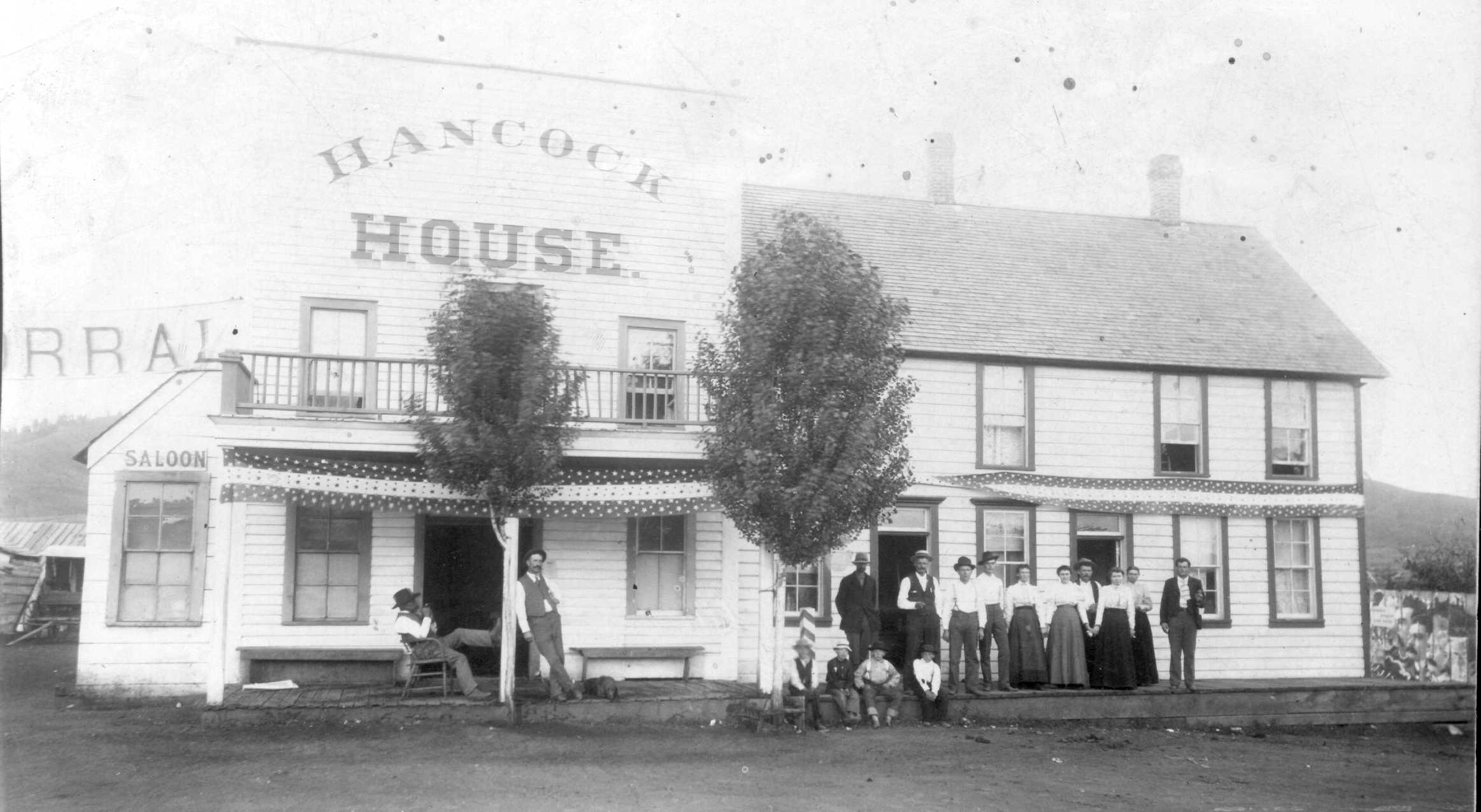
With the news that the railroad was being built up the Weiser River, the communities all along the planned route exploded with activity. Salubria, of course, was the only exception, since the rails would be bypassing this well-established town. Meadows residents must have been worried, as rumors circulated that the line would not reach their community. Doubt remained, as the P&IN seemed to have a policy of not revealing their plans until the last possible moment.
Cuprum was growing rapidly. One newspaper said the town had five saloons, one boardinghouse, one store, one blacksmith and 75 people living there, not counting those living nearby. Dr. William Brown of Salubria had a big drug store / office erected and was in the process of moving there. He had contracted with the P&IN to treat ill and injured workers who were beginning to work on railroad grades to the mining district. (The line was never built, although several sections of grade were built.)
Salubria Citizen, July 7, 1899 – Council has 3 general stores, 3 saloons, 2 hotels, and a number of boarding houses, 2 blacksmith shops, two feed stables, a meat market, a drug store, a jewelry store, a barber and a dentist. By the end of the year, the Signal claimed Council, and possibly Cuprum, had “doubled in size.”
The road between Council and the mining district was busy with freight traffic hauling goods to the mining camps and returning loaded with copper ore. The Citizen claimed 15 to 20 teams were employed hauling ore from the Blue Jacket to the RR at Weiser.
By this time the wooden bridges and culverts that had hurriedly been installed on the road to the mining district had started to rot and fall apart. This became a serious problem and raised an outcry from those using the road.
Late that summer, a good vein of gold was discovered at the Ford Brothers “Summit” claim overlooking Black Lake.
In September the Idaho Industrial Institute was incorporated at Weiser. It would serve as a high school for several generations of students attending from many miles around. They came primarily from communities that didn’t have a high school.
In September a telephone line reached Salubria and a phone was installed in the Inland Hotel. The line was following the new railroad, which of course deviated to the new town with which the railroad was replacing Salubria. That new town had been dubbed “Lewisville” until about this time, after Lewis Hall, one of the principal owners of the P&IN. The Postal Department refused the name because it was too similar to Lewiston and could cause confusion. The name “Cambridge” was settled upon in honor of the hometown of Hall’s alma mater, Harvard. The first train pulled into Cambridge on December 29, 1899.
By the end of the year, the Signal described Cambridge as having 35 carpenters at work, 9 buildings under construction, 60 voters living there, two hotels, “2 restaurants and dry goods business.”
Building of the railroad grade far outdistanced the laying of rails, with teams of workers spread as far north as the Weiser River canyon north of Council Valley. By November the accompanying telephone line had reached Council, and a phone was installed in Hederlite’s drug store.
Early in the year, the Signal reported that Elizabeth Moser had sold lots to the P&IN on the west side of the developing town of Council. By the end of 1899, growth of the town had started gravitating in that direction, with the construction of several new businesses. This could be a factor in naming a street on the west side of Council “Main Street” – the name by which it is still officially known – when it never became a main street.
Whether it was intentional deception or not is unclear, but the P&IN eventually changed its plan and put the depot on the east end of town. A few years after that, it would reroute the line to the west side of town.
William Perrill, an attorney from Texas, arrived in Council in late 1899 and established a “Council Townsite Ltd.” office downtown. He bought 40 acres on the east side of town from John Hancock and immediately plated it as the “Perrill Division” of Council.
“Judge” Perrill was apparently an alcoholic. Only five years after establishing the section of the town named after him, he was arrested for writing a bad check in Provo, Utah. The newspaper there listed him as a “transient” and a “habitual drinker.”
As construction of railroad grade neared Council, references to “soiled doves” living in tents on the edge of town appeared in newspapers. Mentions of a “little brown house” by the Weiser river bridge at Cambridge evidently referred to a house of ill repute.
Born in 1899: Edith Grossen Selby, Loyal Campbell. Died in 1899: Clark Harrington; John Cuddy (Nov. 9); Cuprum hotel man Jacob Clark; Salubria Baptist minister E.N. Elton.
100 years ago
June 17, 1926
A boy was born to Dr. and Mrs. R. T. Whiteman.
Died: Carter Frasier, 20, of Indian Valley, the son of Mr. and Mrs. J. W. Frasier of Indian Valley.
Died: Thelma Clure, age 2, daughter of Mr. and Mrs. Chester Clure.
75 years ago
June 14, 1951
Died: Noah Widner, 70, son of Harvey Widner and Sarah Ross. Born in Missouri, he came to Idaho with his parents by covered wagon when he was one year old. He grew up in the Middle Valley.
49 years ago
June 16, 1977
Irrigation water is in short supply. A severe lack of snow melt has brought the river temperatures up far ahead of normal years. River flow in coming weeks will probably not be sufficient to maintain water quality for safe swimming.
25 years ago
June 7, 2001
“In an effort to conduct business more efficiently, Idaho Power Company will be closing its Cambridge Operations Center this summer. Two company employees will remain in the community to respond to emergencies and maintain power lines in the area.”
Died: Robert D. (Bob) Wood, 73, Cambridge.
Died: Lola May Johns, 94, formerly of Midvale.