
During the first days of 1900, I’ll bet people had to get used to an entirely new set of numbers to write the year. I wonder if it seemed as strange as our transition to the year 2000.
1900 started with the new P&IN railroad having reached Cambridge just a couple days before the new year. The infant town was undoubtedly exploding with construction and real estate deals. Salubria businesses started relocating to Cambridge. The one advantage that Salubria had over Cambridge was that all wagon traffic still ran through it. But it was not enough to keep Salubria alive.
Having to take a circuitous route through Salubria to reach Cambridge by wagon road was an inconvenience for non-train travelers and freighters, and construction of a more direct road between Midvale and Cambridge was advocated. However it would be another 17 years before a road was actually built up along the Weiser River, through the “Jewell Canyon” in 1917.
In March, the Salubria Citizen newspaper, which was published in Salubria, moved its office to Cambridge and renamed the paper the “Salubria Valley Citizen.” However, the masthead of the first issue simply read, “THE CITIZEN.” Almost immediately the masthead of subsequent issues read “Cambridge Citizen.”
In Council, a big dance was held to celebrate the opening of a new hotel. Daniel Moore was calling a square dance when 33-year-old Sam Harpham showed up – drunk, as he often was. Harpham didn’t like the dances Moore was calling and became rather obnoxious about it. The two men took a few punches at each other before Harpham pulled a pistol and fired at Moore. The bullet missed Moore but struck a Mrs. Fisher who was “waltzing just behind Moore.” Moore drew his pistol and fired two or three times at Harpham, hitting him in the chest at least once. Harpham died about 30 minutes later. He was buried in the Kesler Cemetery. Mrs. Fisher evidently recovered, as there is no further mention of her in newspaper reports.
The fiddle that was being played at the dance at which Harpham was killed is now on display in the Council Valley Museum.
Sam Hapham, as one newspaper noted, was “considered a bad character.” His name was usually misspelled as “Harphan” in area newspapers. Evidently going from the misspelling, his local nickname became “Hard Pan,” – a reference to his hard, obnoxious personality, at least when drinking.
Sam Harpham and his wife, Annie, had a son named Bert who was born in 1890. They also had two younger daughters. Bert married a woman named Verlie at Baker, Oregon in 1915. They had no children before he was killed in action in France during WWI (August 1918).
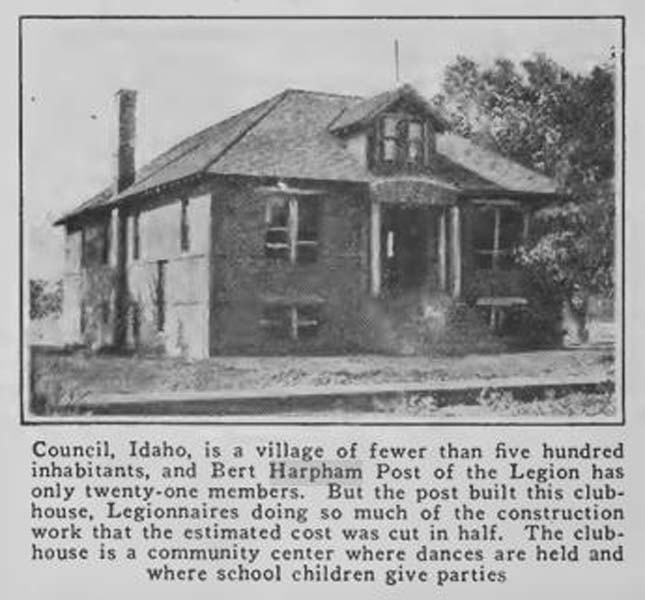
When American Legion Post #72 was established in Council in 1919, the post was named in honor of Bert Harpham.
Still imagining that a railroad to the Seven Devils Mining District would be the answer transporting ore out of those mountains, P&IN leadership had a route surveyed up Price Valley. Little work was done on that route (if any) before a shorter route was surveyed up Hornet Creek from Council in 1900. Some work began on creating a grade in a few places along this surveyed route, but the line was never built.
Early that summer, the Rocky Mountain Bell Telephone Company started placing telephone poles along the road up Hornet Creek, and by mid-summer Cuprum had phone service.
The Cambridge Citizen reported that between 60 and 100 teams were regularly traveling the road between Council and the mining district. It said The Blue Jacket Mine alone had 40 to 50 teams busy on the road.
In June, someone used dynamite to blow up the Chinese “wash house” in Council. Hatred of Chinese and Japanese people was openly expressed in public.
When referring to dynamite, people in those days usually called it “giant powder.” Giant Powder was actually a brand name of dynamite. Dynamite inventor Alfred Nobel granted exclusive U.S. manufacturing rights to a San Francisco businessman, Julius Bandmann, and Bandmann’s company manufactured “Giant Powder” brand dynamite. “Giant Powder” sounded powerful and was easier to advertise to miners and railroad companies than “dynamite,” which was still a new, unfamiliar word.
There were competing brands, like Hercules Powder, Atlas Powder and Judson Powder. Brands of dynamite were somewhat regional, but Giant Powder was the first licensed by Nobel and it became the dominant brand used in the Western U.S. “Giant Powder” was so common that it was very often used as the generic name for dynamite, much as the same way people say “Kleenex” for any brand of tissue.
Before summer even got into full swing, another gun fight happened in Council.
Charles Bowman came off a two day drunk to discover he had no money. He had evidently lost it playing games of chance in, as Judge Frank Harris called it, “a bawdy house with saloon and restaurant connected” owned by a man named Bassett. Bowman went to Bassett’s establishment and demanded his money back. On being refused, Bowman left, got a gun, came back and leveled it at the bartender. The Cambridge Citizen had an amusing way of recounting the bartender’s reaction: “Just at that juncture the bar-tender had business behind the bar in the region of the floor.” Mr. Bassett, the owner of the saloon, entered the scene carrying a gun. When Bowman turned the gun on him, Bassett fired, hitting Bowman in the elbow and stomach. Dr. Loder was called, and he amputated Bowman’s shattered arm, but Bowman died within a day or two.
I’ll have more on 1900 later.
I recently put a new batch of guided tours for sale in the Council museum. It covers of the entire area between Council and the Seven Devils Mining District and tells about all the history along the way. The entire route is now driveable with almost any vehicle and goes all the way to Sheep Rock, which has a fantastic view of Hells Canyon.
100 Years ago
June 24, 1926
Barney Camp has just opened a barber shop in the old Bradshaw building in Cambridge.
A boy was born to Mr. and Mrs. Ed Widner June 17.
A Portland group will be selling stock for the “Cambridge Flouring Mills Company,” and are planning to build a flour mill in Cambridge.
“The work being done on the middle Valley Hill is now nearing completion.” Crews have been changing the curves and the grades to conform with government specifications. “For several days the travel has been over the new road and there are but a few short stretches yet to be covered with gravel. The grade, which was always an easy one, will now be much easier to get negotiate and will be safer as well. Some curves have been eliminated and practically all have been widened.
75 years ago
June 28, 1951
Married: Olive Coffman and Virgil Fairchild.
A boy was born to Mr. and Mrs. Rex Towell of Midvale on June 24.
Died: Edward J. Hepp. He was born in 1887 in Minnesota and moved to Midvale in 1927 where he farmed. He moved to Pasco, Washington three years ago.
Married: Thelma Carpenter of Eugene, Oregon and Gordon Widner.
49 years ago
June 30, 1977
Jimmy H. Harrington, 33, was killed Friday when the car he was driving ran into a truck after he apparently fell asleep while driving on the Hornet Creek Road.
Progress is being made on tearing down the Cambridge hotel. Bill Noah is the new owner of the old landmark.
25 years ago
June 21, 2001
Died: Art Fairchild, 86, of Midvale.
Died: Ryan Mead, 21, of Weiser in a one car accident on Midvale Hill.