
I stumbled across a newspaper article that said the Portland Trading Company store at Landore “established a banking department in connection with the store” in 1904. Whether this was an actual bank or not is hard to say.
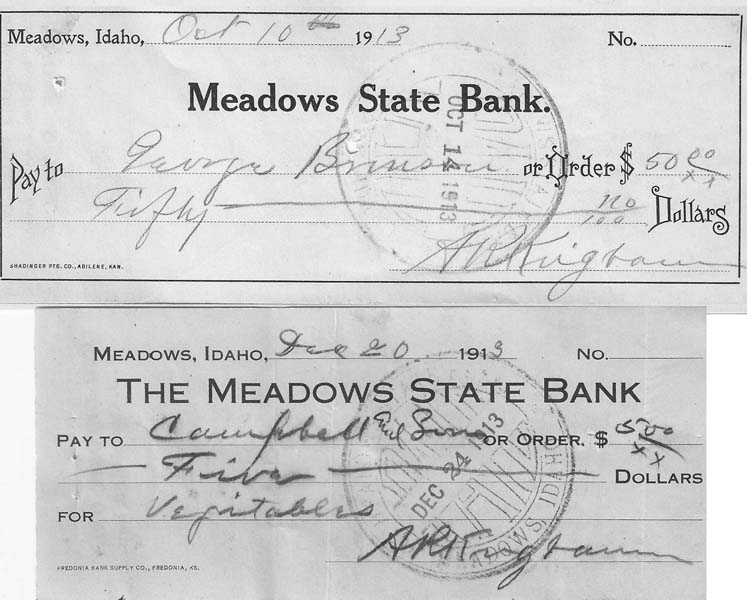
The Meadows State Bank in Meadows occupied a 30-foot-wide frontage on Main Street that was 150 deep and sat right next to the post office.
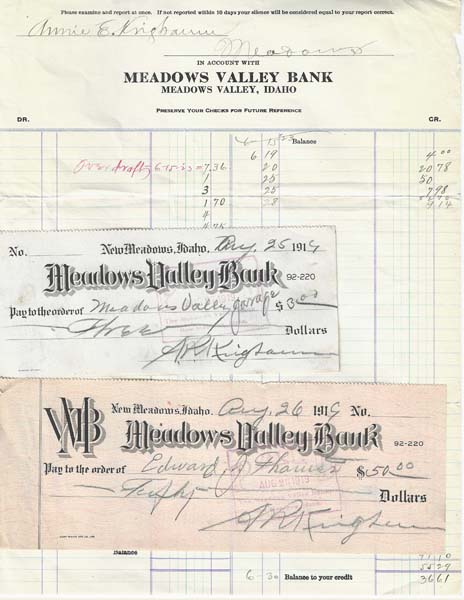
When the Pacific & Idaho Northern Railway established the new town of New Meadows in 1910 – 1911, a new bank named the Meadows Valley Bank was organized there. The owners built a two-story brick building a short distance south of the present-day New Meadows Post Office. Lee Heighley, engineer for the P&IN, was an official in the new bank. In later years the lower floor contained the Post Office and a doctor’s office. The upper floor housed the IOOF, Rebekah and Theta Rho meeting hall. When the Odd Fellows charter was revoked, the building was sold. It has been remodeled, and I believe this building now contains an apartment or two.
The failure of the P&IN to reach Meadows, and the creation of a new town served by the railroad, spelled a slow death for Meadows. Businesses started moving to New Meadows to survive, and the Meadows State Bank did not want to be left behind. But Edgar Heigho did not want competition for the Meadows Valley Bank.
Heigho was President and General Manager of the P&IN and served in a similar capacity in the Coeur d’Or Development Company, which created New Meadows. Heigho successfully blocked the Meadows State Bank from moving to the new town for several years, but in 1914 the Bank Commissioner in Boise gave the Meadows State Bank clearance to move to New Meadows.
Cashier Parker V. Lucas (who was also an attorney by this time) moved the Meadows bank, building and all, to New Meadows.
The two banks competed for a while, but New Meadows was likely too small to support both. In 1916 the two banks merged under the name Meadows Valley Bank in the brick building mentioned above.
Meanwhile, in Council in 1914 the First Bank of Council merged with the Council State Bank.
Things went relatively well for banks across the country until after WWI when the struggling agricultural economy was left out of the “Roaring ‘20s.” Many communities that were dependent on farming and ranching were hit hard. Even so, the financial mentality at the time was that the economy was strong, and banks tended to be overly optimistic when granting loans and putting money into speculative investments. Banks began to fail. Restrictive Federal Reserve’s policies exacerbated the economic downturn. Lack of confidence in the banking system led to local banking panics in which depositors rushed to withdraw their money, causing banks to collapse all over the U.S.
The Washington County Bank at Midvale failed in April 1923.
The News, Cambridge, April 13, 1923: “Midvale Bank Fails – News came over the wire early Tuesday morning that the Bank of Washington County also known as the at Midvale had failed to open its doors that morning. Overloaning is probably the cause, and not being able to realize on the loans.”
The News, Cambridge, August 8, 1924: “Weiser is now without a banking institution, as the Weiser Loan & Trust Company, a state bank, the last of the city’s banks, failed to open for business at the usual time Friday morning.”
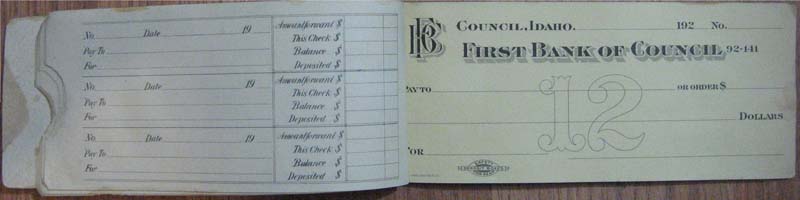
N.H. Rubottom took over the First Bank of Council in 1923. In January of 1926 the bank suddenly closed its doors. The failure of this bank was one of the most traumatic events in Council’s history. Many area businesses and individuals lost all the money they had in the bank. Rubottom became local public enemy number one.
That December, Rubottom, was arrested and charged with embezzlement of $1,300. Almost a year later (November 1927) his trial was moved to Weiser. Hatred of the man ran so high in the area that enough unbiased jurors could not be found around Council. Local tempers were not calmed when Rubottom was found not guilty. In spite of the verdict, resentment toward Rubottom was strong in Council and he moved to Portland. Many people blamed Rubottom for the bank failure until the day they died.
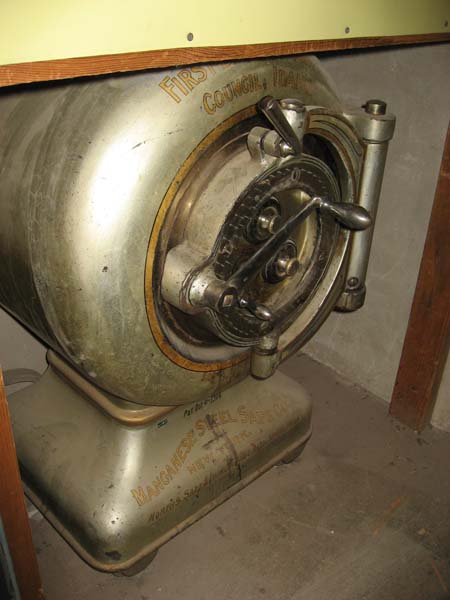
Adams County bought the First Bank of Council safe in 1926 for $350 and moved it into the courthouse. When the old courthouse was demolished in 2017, the safe was salvaged and is now in the Council Valley Museum. The safe still has “First Bank of Council” printed across the front. The bank building was sold in 1927 and has since hosted a number of businesses.
Adams County did not let the issue of its lost money rest, and took the bank to court. The case went all the way to the Idaho Supreme Court in 1928, and the county won. In January 1929 the Adams County Leader announced: “At last! Adams county has a check for $20,422.25, which is the amount of special deposit held by First Bank of Council when the bank closed.”
That October the stock market crashed and banks all over the country started falling like dominoes.
100 Years Ago
January 2, 1925
The Rush Creek power plant hopes to produce power by Saturday night. “The elevator has been hit hard, along with many others, and are unable to turn a wheel.”
Married: Lawrence Schlehuber of Cambridge and the Pearl Garrett of Pocatello.
A boy was born to Mr. and Mrs. A. D. Snider December 24.
“Reports come in that about 60 head of deer or wintering a few miles above Indian Valley on the Little Weiser. That section, we are told, was a great winter range at one time years ago and deer were to be seen there by the thousands. Our informant says, moreover, that when the deer feed there it is a certain indication of a moderate winter. Some of the old-timers can recall when the deer in this valley were plentiful.”
75 Years Ago
December 30, 1999
Died: Duane Baker “Bud” Anderson, 65, of New Meadows (Pine Ridge).
Died: Alvin W. Abrams, 81, of Cambridge.
Died: Roy W. Curts, formerly of Midvale. He was born in Oregon in 1909 and moved to Midvale in 1914 where he lived until 1966.
49 Years ago
Missing issue
25 Years ago
Adams County Record, Dec. 30, 1999
Adams County Commissioners continue to hope that the move into the new courthouse / jail will be made in the first half of January.
The Dept. of Health and Welfare, Licensing and Certification Division, informed Council hospital trustees that they would accept the current operation plan for the nursing home, hospital and clinic. The doors will stay open.
Dr. Sinkinson opened his new clinic in Council’s business park, but the decision to lease the space is controversial.
Council Telephone announced last week that it achieved its goal to be Y2K compliant.