
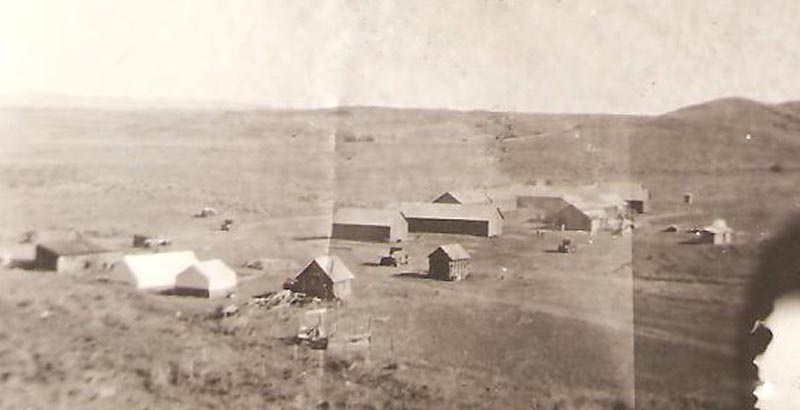
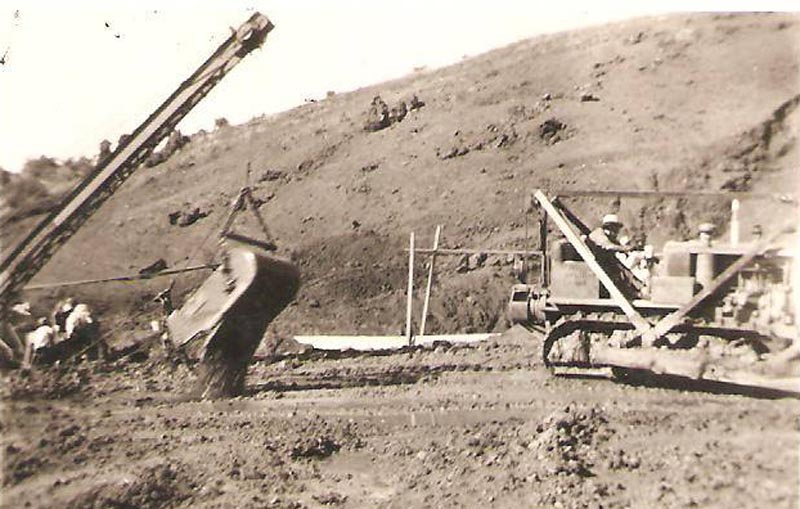
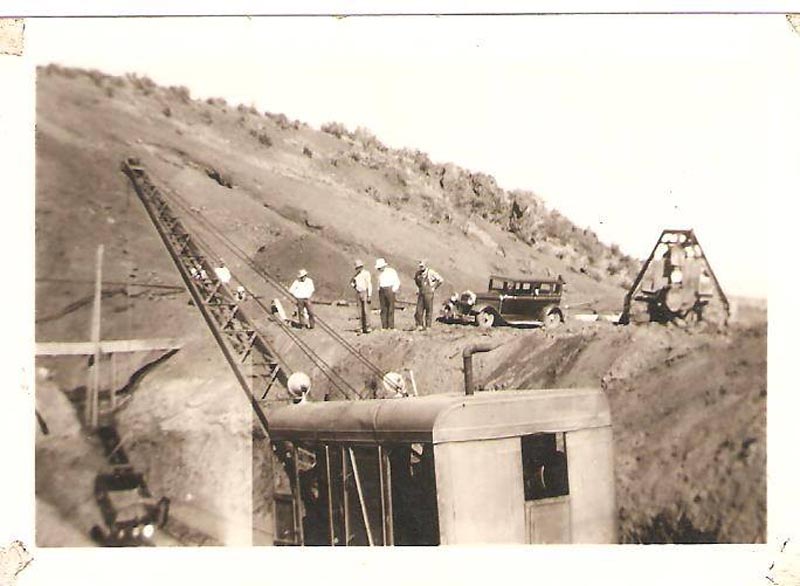
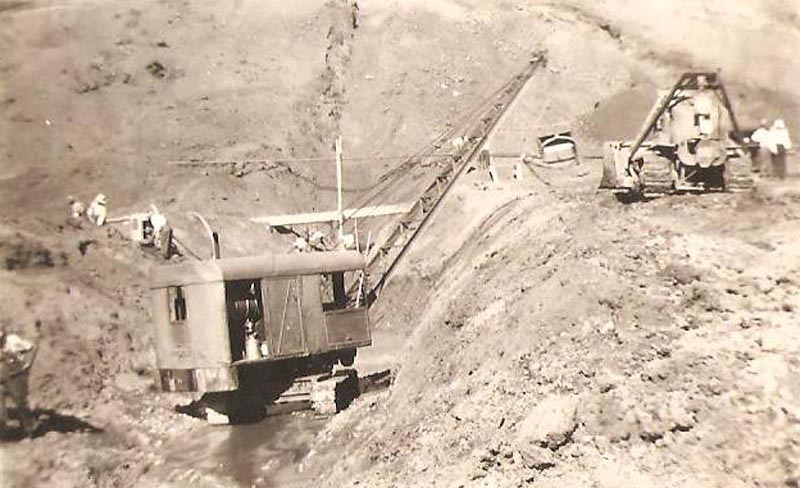
The photos here show the 1936 construction of the dam and associated elements that would form the C. Ben Ross Reservoir, just over two miles (as the crow flies) south of downtown Indian Valley.
After Franklin Roosevelt was elected president in 1932, he instigated a number of programs to counter the Great Depression. The Works Progress Administration (WPA) was a cornerstone of Roosevelt’s “New Deal.” From 1935 to 1943, the WPA employed over 8.5 million Americans; built 650,000 miles of roads, 125,000 public buildings, and 800 airports; and sponsored cultural programs like the Federal Writers’ Project, which collected slave narratives and oral histories.
It’s not clear when he first started working on the project, but at some point Ellis Snow spearheaded an effort to get a reservoir established to provide badly needed irrigation water for farms along the Little Weiser River (Indian Valley) and downstream from it. In the spring of 1936 he worked with the WPA on behalf of the Little Weiser Irrigation District (which “sponsored” the reservoir project). Also involved were attorneys Carl Swanstrom and George Donart.
The Bureau of Reclamation also played a key role in establishing the reservoir, as part of its broader mission to develop water infrastructure in the West. It was a separate entity from the WPA, but their efforts occasionally intersected.
In April, even as final details were being hashed out with the WPA, work had started. The Adams County Leader said: “Equipment designed to do fast and efficient work has been promised and should be on the ground promptly. Camp is well established so that no impediments are in the way for rapid prosecution of the job.” “Provision has been made for two supplemental units, additional to the original plans. An intake canal and a diversion canal are to be built. Surveys for these are being made.”
For a few months, the reservoir didn’t seem to have a name. The June 19, 1936 Leader headline simply said: “Reservoir Work Progressing Nicely.” The article in that issue read: “The compressor has been operating during the past week drilling the rock for corewall and tunnel. A drag line shovel, running two shifts daily is excavating the corewall trench and a new 45 horse power diesel bulldozer is busily engages at stripping the top sail from the damsite. Three dump trucks are under contract and expected to arrive at the dam Thursday. A second steam shovel of one yard capacity has been requisitioned for the job. As soon as a lighting plant can be installed it is planned to operate day and night.”
That summer news of, and speculation about, irrigation water appeared regularly in area newspapers. Mesa Orchards sold 3,000 acre feet of excess water rights (“A” shares) and planned to use the money to repair the deteriorated flume. A reservoir at Price Valley was proposed. It didn’t seem to be a new idea at that time, and it would be contemplated again for years to come, but it was never built.
In October, Ellis Snow was concerned that the reservoir would not be completed in time to provide farmers with water the next summer (1937). He persuaded the state highway department to make their steam shovel available for the construction job. The additional big shovel sped up the work. The Leader said, “The outlet tunnel is progressing satisfactorily, forging through sold rock; now 150 feet with about 250 feet to go.”
At that same time, the name “C. Ben Ross Reservoir” appeared in the Leader for the first time. Charles Benjamin Ross was Idaho’s governor at the time (from 1931 to 1937). He was Idaho’s first native-born governor and the first to serve two consecutive terms in that office. Ross was a rancher and a strong advocate for agricultural development and rural infrastructure.
By December the earthen dam was finished and the entire project only had a few odds and ends to wrap up. Yet to be completed were: intake canal, putting in the headgates, lining the outlet tunnel and a few other “incidental” jobs. The Leader said, “The first annual election of directors will take place next Tuesday.”
Ellis Snow was said to be “all smiles,” stating the reservoir was, “a dream I have had for thirty years.”
Some work on the “incidentals” may have continued into 1937. That winter and spring the reservoir stored water that was used for irrigation that summer.
For some reason, the Bureau of Reclamation held a dedication ceremony for the reservoir more than two decades later, on August 18, 1959.
Today, besides providing irrigation water, the 357-acre reservoir is a popular fishing spot.
100 years ago
August 7, 1925
“Two carloads of coal were placed in bins over town the first of the week.”
The new state fish hatchery to be built at Evergreen on the Weiser River will be constructed using lumber from the Snow & Lafferty sawmill at Evergreen.
75 years ago
August 3, 1950
Died: Mrs. Ann Zella Welker, who had been a resident in Washington County since 1902.
“Notice – Dumping of trash is prohibited on Weiser River at the Fred Bain place.”
Grays Creek- Alpine: “Mrs. Walter Grossen gave a birthday party for her son, Tommy, last week. Over 20 little friends attended besides their mothers.”
49 years ago
July 22, 1976
The Council community Hospital Board of Trustees granted staff privileges to Dr. Richard O. Vycital of Boise. Hospital administrator Jerry Hart reports that the doctor will be coming to Council to perform surgery on and “as needed” basis.
Midvale is having a problem with many people being unable to get any water for domestic use. “It was decided to set up a schedule that we hope will relieve such a heavy drain on the well during the day.”
25 years ago
July 27, 2000
Died: Erma E. Armacost, 82, Council. Graveside services will be at the old Meadows Cemetery.
Died: Fern Mallory, 75, of Weiser, formerly of Midvale.