
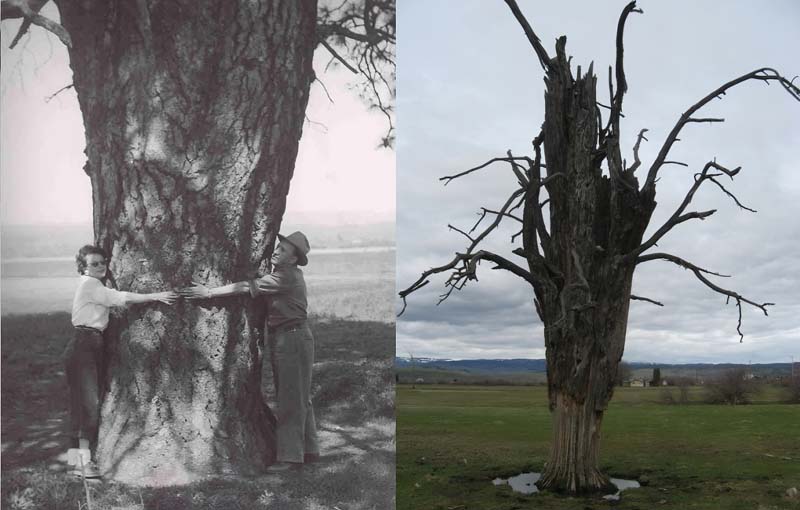
If you Google “Council Tree,” there are not too many relevant results. A few native tribes in a few areas apparently had a specific tree where people would meet. Whether this was a purely native practice, or whether such trees acquired this label after Euro-Americans started meeting with Indians, is not clear to me. At any rate, the concept seemed to be commonly known to western settlers.
But, as I wrote last week, the big trade gatherings here were not “council meetings,” so designating trees under or near where a couple thousand native people would gather as “council trees” is a misnomer at best.
The idea that Indians meeting in the Council Valley met at a certain tree or trees is based on second or third-hand accounts, all from people who were not living here at the time the Indians met here. It is clear that early settlers here thought five big pine trees just northwest of present-day Council was where the big trade rendezvous were centered, and they came to be called “Council Trees” by those settlers.
Until the 1920s there were five pine trees in a field at that location, but the landowner later cut down all but one of them. Hugh Addington remembered the trees as standing more or less in a row.
In 1930 Rose Freehafer wrote a school essay in which she mentioned the Council Trees. Rose personally interviewed pioneer, Bill Camp, and quoted him in her essay. Camp, who spoke the Nez Perce language to some extent, said, “I was working for the Indians in the early days, and one of them told me that they the five Council Trees were in the Kesler field.” This field was about three quarters of a mile north, northwest, of Council.
A history paper written by Grahm Doyle when he was in high school here at Council in 1936 also describes the Council Trees as standing northwest of town. Mr. Doyle interviewed Bill Winkler, Robert Young and Matilda Moser to get some of the information he used in his paper. One of the original five Council trees was still standing at the time the paper was written. Doyle said when the Indians met here, they had a “race track” where they would race horses. Robert Young remembered competing in some of these races. Of course this was after the era of so-called “Council meetings,” and Mr. Young would have had no personal memory of them.
In 1917, when Arthur Hallet acquired ownership of the land where the “Council Trees” stood, all five trees were still standing. Arthur’s son, Byron (Buff) Hallet said the last tree died in 1928 and was later (evidently after 1936, according to Grahm Doyle) harvested for firewood. Buff Hallet planted five young pine trees near the location of the original Council trees in 1986. These new trees are growing on the south side of Airport Road, straight south of the Council airport. (Footnote: Some of this info came from a hand written note, signed by Byron F. (Buff) Hallet, that was with a piece of root from of one of the Council trees donated to the Council Valley Free Library during the 1980s.)
For a time, the Adams County Leader newspaper printed a big logo, along with the paper’s name, across the top of the front page of each issue that showed the five Council trees with Indians smoking a peace pipe under them.
As early as the 1920s, the idea existed that an old pine tree located just south and west of where Highway 95 crosses Mill Creek was the one, and only, Council Tree. This idea was revived in the 1960s. The origin of this idea is unknown, at least to me.
It might be that Ralph Finn revived the idea of a single Council tree near Mill Creek. He pushed the idea of making a tourist park at the Mill Creek site. The pine tree growing there was promoted as the Council Tree.
The idea of the Mill Creek Council Tree was still very much alive in 1975, as a local newspaper contained this: “The Galey family of Boise, former residents of Council, were owners of the property the Council Tree is located on. They offered to donate a portion of the property for development of a roadside Park. The Idaho Division of Highways determined the area adequate to build a safety rest area, describe that portion of the property, and contacted the Galey family. On December 31, 1971, Frank S. Bailey, Jr., and Gwendolyn R. Galey sold the land to the state of Idaho for $10.00, providing the property be used for development of a rest area. The rest area would eventually include provisions for sanitary facilities, picnic tables, landscaping, as well as a display to tell some of the history of the Council Tree and the local area.”
The state still owns a small piece of land there, but it has never been turned into any kind of public area. I suppose the Indians could well have met at more than one location over the few times the gathering was held here, so it’s possible both places are “legitimate.”
So there you have it. Council was named for council meetings that pretty much never happened, under or near a tree or trees whose nature or meaning may be based on little more than a guesswork and assumptions by early settlers who didn’t understand native culture. It has been my experience that people like a good, romantic or dramatic story much more than a mundane true account, and those stories are the ones that seem to endure.
100 years ago
March 14, 1924
A girl named Edith Erlene was born to Mr. and Mrs. Earl Watts March 8.
Dave Jones and Ray Bradshaw were arrested, separately, on a charges of illegal possession of intoxicating liquor. 22 gallons of moonshine was taken from Jones’ barn. “In a raid in the vicinity of Midvale Saturday the Sheriff arrested Bert Fleming and got a complete still outfit and a quantity of mash. And later, in another raid in the same vicinity, Alfred Dishion was taken into custody and with him a still and 2 gallons of the alleged finished product. Both men were brought to the county jail and are being held there pending their preliminary hearings.”
“Dr. Briggs of Council...”
75 years ago
March 17, 1949
“Pine Creek: Mrs. Lila Ward and Kenneth Downey were united in marriage at a quiet wedding in Winnemucca Saturday.”
“Midvale: The W. C. T. U. organized here Friday afternoon at the Baptist Church.” Women’s Christian Temperance Union
About 35 farmers of the Midvale area organized a Midvale local of the Washington County Farm Bureau.
Died: Alfred H. Weeks, 77. “Mr. weeks, a former longtime Washington County rancher, came here many years ago and operated ranches at both Cambridge and Midvale.” Burial in the Hillcrest Cemetery.
Died: Anna R. Mize, 81. Burial in the Keithley Creek Cemetery.
49 years ago
March 13, 1975
A major improvement of Highway 95 between Cambridge and Council is underway a 150-foot concrete bridge over the Middle Fork of the Weiser River has been completed. The alignment of Highway 95 from Mesa south to the Alpine store for 4.6 miles has been graded. Also included in this project will be paving of a 10-mile section of highway from Council north. “The original highway was started with a bond issue of Adams County residents in 1916. It is one of the only two counties in Idaho that had a bond issue to begin a state highway. From Cambridge to Council, Highway 95 – with the exception of about 300 yards located in the Alpine area – is exactly on the same route, the same gradient and the same curvature as it was back in 1917 to 1919 when first built.”
“Roadway construction and bridges over the numerous streams were completed from Cambridge to the Washington-Adams County line by 1918. Not until 1924, however, was the road opened all the way to Council. Paving was done between 1930 and 1933 on the entire stretch.”
Referring to a tree west of highway 95 near the highways junction with Mill Creek Road 3 miles north of Council, which is rumored to have been “the Council Tree” where Indians from all over the Northwest would gather: “The Galey family of Boise, former residents of Council, were owners of the property the Council Tree is located on. They offered to donate a portion of the property for development of a roadside Park. The Idaho Division of Highways determined the area adequate to build a safety rest area, describe that portion of the property, and contacted the Galey family. On December 31, 1971, Frank S. Bailey, Jr., and Gwendolyn R. Galey sold the land to the state of Idaho for $10.00, providing the property be used for development of a rest area. The rest area would eventually include provisions for sanitary facilities, picnic tables, landscaping, as well as a display to tell some of the history of the Council Tree and the local area.”
25 years ago
March 18, 1999
Delays can be expected on Highway 95 at Weiser during construction of the Weiser Alternate Route.
Died: Raymond H. Pomeroy, 71, of the Midvale-Cambridge area.
Died: Samuel Linden “Hap” Preston, 86 of Midvale. Burial in the Eastside Cemetery.
A directive to transfer Indian Valley students from the Cambridge school district to the Council school district has been dropped. “Overwhelmingly, the majority of Indian Valley families favored the Cambridge school district. Both districts have an open enrollment policy, therefore, parents have the freedom to enroll their children in whichever district they believe their children may receive what they prefer them to get from their education.”