
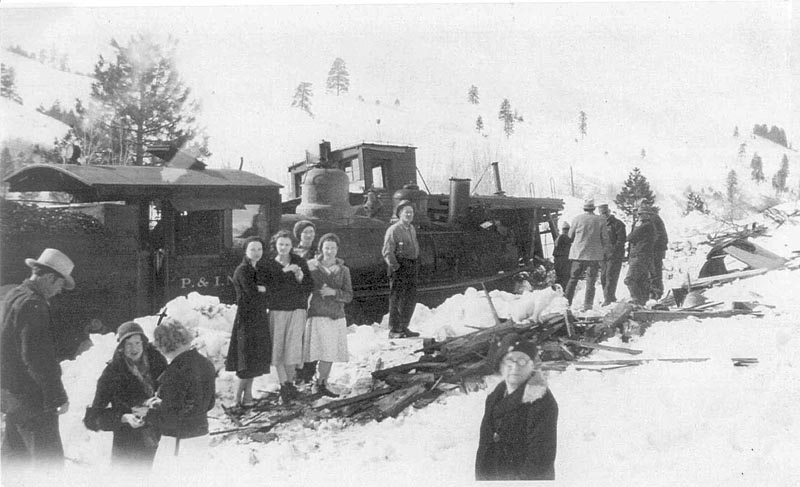
Railroads were a vital part of life for the people in several generations before us. But they could also bring death. The momentum of hundreds of tons of steel gliding along a couple of rails could result in catastrophic wrecks, such as the one that occurred just north of Fruitvale in March, 1933. The railroad between Council and New Meadows was so packed with snow that no trains could get through. The P&IN put a special plow to work to clear the tracks. Harold Burt, who lived at Fruitvale, was one of the young men on the crew sent up the line with the snow plow. He wrote an account of what happened:
There were two engines (steam locomotives) driving the old snow plow (which we called a “wedge plow”) and they had a box car and caboose on behind. Charley (Harold’s brother), Harry Spear and I were riding up front in that old wedge plow, along with another fellow (Ralph Bass) who was riding on the “cupola” on top of the wedge plow. His job was to control the flanges, which cleaned out the inside of the rail, and had to be raised up when we came to a crossing or a switch.
When we went through Fruitvale they had both engine’s “ears pulled back” and they were wide open, throwing the snow along the right-of-way fence fifty feet away. Charley was leaning on the brake wheel, and I was holding onto the rail by the stairs that went into the cupilo. As we watched out the window, Charley said, “Boy! We’re really going! If anything happens and this thing jumps the track, we’re gone!” It didn’t worry us much, but we were concerned.
Up by Fred Glen’s place (about a mile north of Fruitvale, at what is now Scism’s driveway,) where his crossing was, there had been water coming down the old Robertson-Sevey ditch, and had run over the bank of the ditch—on down under the snow and over the top of the rail. It covered the right-hand rail, and had frozen solid.
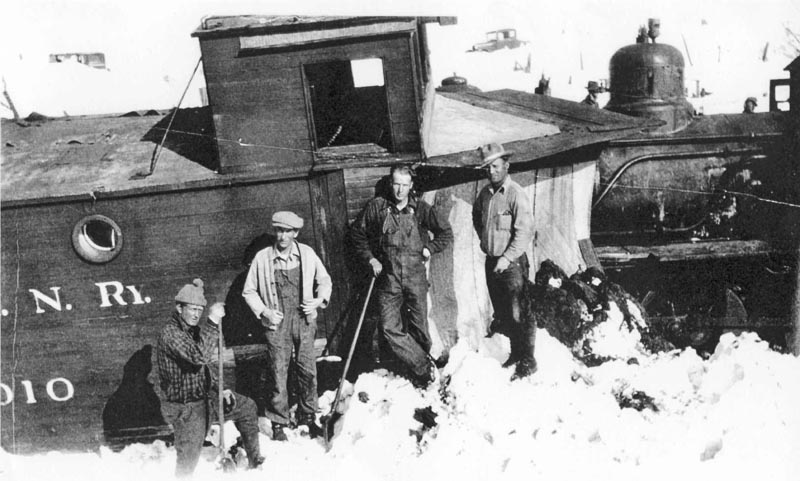
When that old snow plow hit the ice it jumped in the air, came down on the left side of the track, and headed into the left hand side of that big cut by Fred Glenn’s crossing. It drove the nose of the snowplow into the bank, throwing tremendous pressure on the front end of the first engine. When the engines went by, they tore the whole right hand side out of that wedge plow. The right hand rail had given away, causing the first engine to swing to the right, diving into the right bank of the cut, clear up to the head light before they stopped.
Those 6X6 hardwood beams and planks that the wedge plow was built out of were splintering up, and pieces of hardwood, tools, dust and debris were sailing past Charley and me, and I couldn’t see a thing. When we stopped, the snowplow was turned completely around, headed back towards Fruitvale.
Old Sy Winkler’s son in law Ralph Bass, who was riding in the cupola was thrown right out the window. He went down the front of the wedge plow and headed down the track as hard as he could go. He ran into the Fruitvale store and told them they were “killing men up there!”
Charley was knocked out cold, and was sitting up with both eyes open, just like and owl! Blood was pumping out of both nostrils. You could tell the beat of his heart by the way blood was pumping out of his nose. I grabbed him and got him up on his feet, took my handkerchief and tried to stop the bleeding. I said, “Come on Charley, let’s get out of here.” I went out through the side of the snowplow and carried him up onto the snowbank and laid him down. He was out cold!
The first thing Charley heard was someone holler, “Is anybody killed down there in the snowplow?” Someone hollered “No,” and then the fellow said, “We got one dead man on the engine.” That man was Pete White.
Pete had been riding on the first engine and was supposed to be shoveling coal down to the fireman. He must have jumped down off the “tender” and was standing on the apron, between the tender and the engine, looking out to see what was going on as we plowed up the track. He had hold of the “grab irons” between the tender and the engine, and when we hit the ice the engine buckled, crushing him to death. They had to cut the grab irons to get him out from between them.
Finally I got old Charley on his feet and headed down the road for home. His nose was broken, but he was mighty lucky to be alive.
They tell you in the (Mormon) Temple that if you wear the Garments they will be a “shield and a protection.” Charley had on his garments and he always wore other underclothes over them in the winter time. He also wore a heavy shirt and coat. A hardwood splinter had went across his back, through his jacket and all of his clothes, and out the other side, just like and arrow, cutting a hole an inch and a half long. It never scratched his garments. Had it not been for his garments it would have killed him dead as a hammer.
Harold refers to the man who was killed as “Pete” White, which must have been his nickname. When the Adams County Leader reported the wreck, it said White’s first name was “Garland.” White had been a P&IN employee for several years on the section crew. White had only been married the year before, and had a four-month-old son.
100 years ago
August 28, 1925
“A roadshow company entertained a small crowd at the Elk Hall Monday evening.”
“Many from the rural communities who are planning on moving to town for school are busy securing locations and making arrangements for the winter this week. But with one or two exceptions, every available house in town has been rented or the school year.”
“There has been considerable growling among an indignant people because the townsite is overrun with horses every night.”
“Mr. and Mrs. Friend Moore and daughter, Helena, of La Grande, Oregon, were here several days visiting friends and looking after business interests they returned home Saturday.”
“A fire at Council last week destroyed several buildings, including the blacksmith shop, a rooming house and other property.”
W. H. Harker reports a hard freeze in Meadows Valley Monday night, with half an inch of ice at his ranch.
75 years ago
August 24, 1950
Idaho power plans to extend electric service up West Pine Creek. Work will begin this week at Midvale to bring service to the Kermitt Stippich, Hugh Snapp and George Garner ranches, and work will start soon to extend lines to the James Shumaker, Roy Curtis and Ed Benthin places near Cambridge.
“Eddie Ludwig’s first in professional baseball is proving a successful one. The Cambridge lad is booming along with a record of seven wins and three losses, which is respectable indeed for a first-year man, only 2 1/2 months out of high school.”
49 years ago
August 12, 1976
A son was born August 6 to Mr. and Mrs. Gary Gallant at the Weiser hospital.
25 years ago
August 17, 2000
“The old Salubria school house, which has been sitting near the intersection of the Salubria Road and Burton Lane, finally found the weight of the year too much to bear. It collapsed sometime in the second week of August.”
Died: Patricia Louise Armacost, 63, Cambridge.
Boyd and Phyllis Mink of Nampa, formerly of Cambridge and Council, celebrated their 50th wedding anniversary.