Gold was discovered in what is now Idaho in 1860, ‘61 and ‘ 62, at the mining camps of Pierce City, Orofino, Elk City, Florence and Warren. Thousands of fortune seekers stampeded to these areas. John Hailey (1835 - 1921) wrote about his experiences in transporting many of those fortune seekers.
Hailey came to Idaho Territory in 1863, was elected to Congress (1873 – 1875), elected to Idaho Territorial Legislature 1881 and 1884, was the warden at the state penitentiary in 1889, and he wrote the “History of Idaho” books. The town of Hailey, Idaho is named after him, and he was the first Secretary and Librarian of the Idaho Historical Society.
Hailey said the thought of how much gold the fortune seekers might find got them so motivated that they could “stand any kind of crude transportation, even down to Foot and Walker’s Line.” This was a humorous way to say they walked.
Most of the rest of this column is quoted from an article written by Hailey. His story begins after the initial gold strikes north of here.
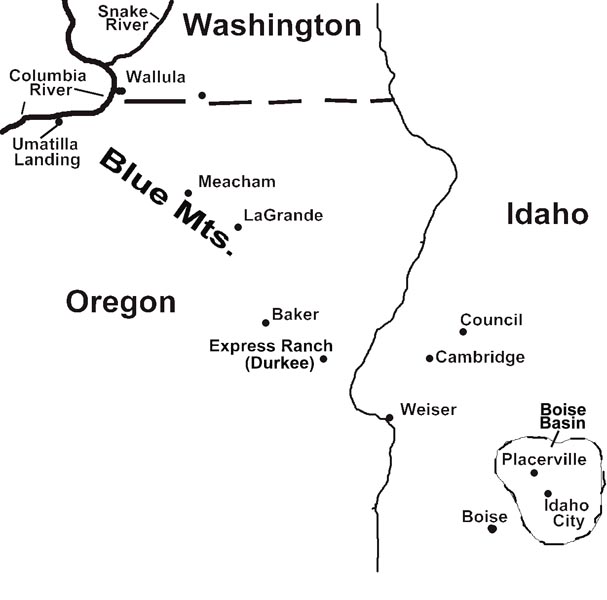
“Next came the biggest and greatest rush from California and Oregon to the Boise Basin where gold was discovered in 1862. This great rush came in 1863, by steamer up the Columbia River and landed at either Umatilla in Oregon or at Wallula in Washington Territory. From either place it was 300 miles travel to the mines. When a steamer would land at Umatilla with two or three hundred of these gold hunters, one half or more of them would have their packs strapped on their backs ready to start soon as the gang planks were put out and most of them hit the road without making any halt in the small town. Each one appeared to want to be in the lead for fear that the other fellow might get there first and get the beset claim.”
Hailey wrote the following from personal experience of operating a “saddle train” and stage lines.
“Some of the poor fellows on foot had a hard time – foot-sore, worn out, and half starved – but they all managed to get there some way.
“However there were several out of each crowd that had money and were more cool headed. They stopped and inquired for transportation. The only transportation at that time was what they called saddle trains. These consisted generally of about 20 horses or mules, 16 with riding saddles and four with pack saddles, which were sufficient to pack the blankets, grips and provisions for 15 people.
“The 16th saddle horse was ridden by the train master, whose duty was to take care of all the animals after they pitched camp each evening, bring them in early in the morning, pack up the baggage an camp outfit on the four pack horses and drive them ahead and see that the passengers all rode behind in good order without any abuse of the animals that they rode, while the trainman furnished the provisions and paid all tolls across trails and ferries.
“The passengers had to do the cooking and at dangerous places each passenger had to take his turn standing night guard to save the animals from being driven off by thieving Indians. Saddle trains would often start out within two hours after the arrival of the steamer loaded and equipped as described above, while the trip was rather hard, but it was healthy living in the open air, day and night. None got sick and most of them improved in health. The passengers were jolly good practical men and understood camp life, so that they usually had a good time on the road, which usually took eight days.” Umatilla to Boise Basin.
Hailey said the saddle train business “lasted from April 1863 to about June 1863, omitting about six weeks in January and February.” Hailey was in the saddle train business all this time and wrote from personal experience, “omitting some very trying scenes and many funny incidents that occurred.” I wish he had written those down!
“Early in the spring of 1864, preparations commenced in Walla Walla by two companies to put on a tri-weekly stage line from Wallula to Placerville in Boise Basin. One of these companies, under the firm name of George F. Thomas & Co., was to stock the road from Wallula to the Express Ranch on Burnt River, half way. Express Ranch was later renamed “Durkee” when the railroad bought its right-of-way from the Durkee family in 1883. The other company, Henry Greathus & Co. to stock the road from Express Ranch to Placerville. This line was for the purpose of carrying passengers and Wells Fargo express.”
Saddle trains converted to a tri-weekly stage line, and by June 1, 1864 that stage line ran from Wallula to the Columbia River via Walla Walla to Boise Basin. Another stage line “ran from Umatilla, which was twenty-two miles below Wallula on the Columbia River, but was about the same distance from the Boise Basin mines as Wallula was. Traveling time was reduced to four days, daylight travel.”
“This mode of transportation was quite an improvement but more expensive than the saddle trains The number of stations had to be doubled; harness and stage wagons purchased at a very high price; the number of employees doubled. The bills for repairs were very costly and the repair shops at long distance from where breaks would occur, necessitating the keeping of extra equipment.
“There was no mail on the route at that time. All mail and express up to this time had been carried on saddle or pack horses by different persons. By or before the first of June it was expected that the wagon road would be in condition for stages to run over them. At this time there was a great rivalry between the people of Wallula and Umatilla as to which place should get the most travel and freight landed at their respective steamboat landings, destined for the Boise Basin.
“As soon as the people of Umatilla heard that there was to be a stage line put on from Wallula via Walla Walla, crossing the Blue Mountains via the Thomas & Ruckels road to Summerville; in Grand Ronde Valley, the people of Umatilla and La Grande called on my partner and me to have us put in a stage line from Umatilla via Meacham road over the Blue Mountains, via LaGrande and on to Placerville in Boise Basin. Before the request was made we had established temporary stations about 25 miles apart, with a change of saddle horses at each station and meals provided at each station for the passengers, traveling two stations each day and making the trip through in six days.”
When the first transcontinental railroad was completed in 1869, the stage and freight lines to Idaho from Umatilla were mostly superseded by lines from Kelton, Utah.
100 years ago
July 31, 1925
“The big press that will serve this office in the years to come, is now erected on our floor.” The machine should be ready to use next week.
“The death of William Jennings Bryan last Saturday night, while asleep, has shocked the entire country.”
75 years ago
July 27, 1950
John Edward “Jack” Donart, 21, of Cambridge, died from polio July 21 at a Boise hospital. He was a 1947 Cambridge High School graduate and the son of Mr. and Mrs. C. F. Donart of Cambridge. He is Idaho’s first polio fatality.
A son was born to Mr. and Mrs. Vernon McClure at the Council hospital.
To be sold at public auction: all buildings at Thousand Springs; a barn at Keithly Creek; land, school house and barn at Highland; land at Sage Creek; school house at Happy Hollow; buildings at Richland, and a Plymouth sedan.
49 years ago
July 15, 1976
Midvale: “Work is progressing on Jack Piper’s the new service station. The old one was destroyed by fire last winter.”
25 years ago
July 20, 2000
Brandon Dopf received his Eagle Scout award and badge. He is the son of Don and Betty Dopf.
“Customers of Cambridge Telephone Company are going to see their local calling area expanded, but they also are going to see monthly charges for residential and business service. The PUC has granted a utility request to provide local calling between the following areas: in Cambridge and Council to Midvale, Weiser, Payette and Fruitland; Council and New Meadows; and Lowman to Garden Valley, Idaho City, Horseshoe Bend and Boise.”