
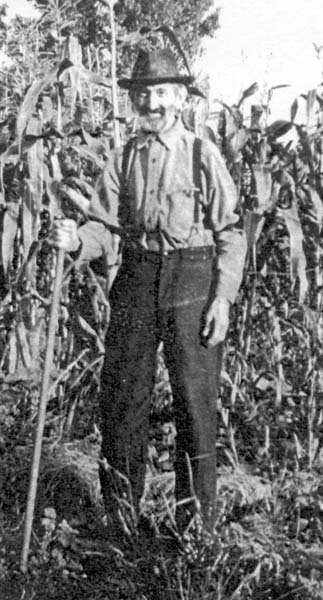
Elmer Milligan established a post office June 4, 1901 along the newly-built railroad near the point where Goodrich Creek (which flows from the mountains to the northwest) joins the Weiser River. This post office and community was known as “Milligan,” and Elmer was said to be the “mayor.” The post office was discontinued in 1906 when Elmer Milligan moved on to become the postmaster at Cambridge. The Milligan Post Office reopened on Sept 10, 1910 under the management of Milford Hopper, and the name was changed to Goodrich. The origin of the name for the creek and the post office is unclear.
Thomas Book became postmaster January 23, 1912, followed by Ashton Roby, November 20, 1913. It isn’t clear just when a store was established at Goodrich. Post Offices were often in stores, so it could well have been that this was the case very early on.
There is some indication that James and Stella Herron had a store and shoe repair shop, beginning in 1913. Whether they had a separate business from that of Ashton Roby or ran the same store at some time is not clear.
Abraham and Anna Schmid bought the Goodrich store from Ashton Roby in 1918. Their son, William Schmid, seems to have been postmaster in 1923 and ‘24, and then Abe apparently took over that role in 1925.
Abe and Anna Schmid ran the store and post office until about 1941 when age caught up with them and they sold the business to their son, Bill, and his wife, Betty. At that time the store and post office was moved to Bill and Betty’s house (near the present Crossley house – 1684 Goodrich Creek Rd).
At some point after the Schmids ran the post office, Bessie Roeder was postmaster. She died in 1952, at which point her husband, Fred Roeder, evidently took over that role until he died in 1957. At that point the Goodrich post office closed permanently.
Records mention Hazel Denney, Effie Ogilvie and Elizabeth Hopper as possibly being the Goodrich postmaster during unspecified years.
Random notes
In 1913 a rumor appeared in the Council newspaper that gold had been discovered at Goodrich. Nothing came of it.
The National Forest grazing allotment on Cuddy Mountain evidently covered quite a wide area, going from the Goodrich area to about as far north as Cuprum. Minutes from a 1916 meeting of the Cuddy Mountain Cattle and Horses Growers Association list members at the south end of the allotment (Goodrich and Johnson Creek ranchers): E. H. Gallant, John Ogilvie, Abraham and Alfred Schmid, C. H. Glasscock. Cyrus Kilborn, James Thorp and Albert Ferguson. Ferguson Basin near Goodrich is named after Albert Ferguson. He died in 1921 at Portland, where he is buried.
In 1919 a sawmill at Goodrich, operated by the Button Brothers, was mentioned in a local newspaper.
There are two unmarked graves in the Goodrich area. One is the grave of a baby named Orvel John Button – Riggs (possibly related to the Button Brothers mentioned above?) and a baby with the last name of Smith. These graves may be in a field – their location lost to history.
In the summer of 1942, either the state or the grazing association in the Goodrich / Bacon Creek area decided the risk of fire was great enough that a “smoke chaser” should be positioned where he could put out any fires that started. On July 1, 1942, Gordon Ader, a young man just out of high school, was given the job of manning what became known as the “Bacon Hill Lookout.” It consisted of a tent on a wooden frame on a hilltop. There seems to have been a phone line running to the lookout.
Clarke Childers said: “I remember it real well as it was in service when I was Fire Dispatcher at Council in the later 1940’s. It was just a high knob on the south side of the old Goodrich road. The old road turned off just this side of the current landfill about 1/4 mile and went west towards Goodrich and hit the current Goodrich road again just this side of the river bridge. The smoke station was about 3/4 of a mile from the current road, and there was a kind of make shift road up to top of a knob. The Forest Service never put a building there – just kind of a camp – and manned it when there was a lightning storm or some other need in fire protection. We had some trouble keeping help up there because there was lots of rattle snakes.”
Apparently funding was more of a factor in the demise of the lookout than rattlesnakes. At some point, money ran out to fund the endeavor, and the “Bacon Hill Lookout” fizzled into the shadows of history.
100 years ago
April 24, 1925
“A. Schmid, Goodrich merchant, was transacting business here.”
A boy was born to Mr. and Mrs. A. Ebner on April 16.
Married at Weiser: Miss Elsie Craig of South Crane and Mr. Ross Cornett of Indian Valley.
75 years ago
April 20, 1950
Idaho Power Company started work Monday morning on a new street lighting system for Cambridge. Seven will be placed on Main Street in Cambridge and five at Midvale.
Married April 8 at Council: Betty Mae Henson of Nebraska and Donald A. Keckler, son of Mr. and Mrs. August Keckler of Mesa.
Died: Midvale pioneer Bessie May Stewart. She was born at Midvale in 1891 to Edmond and Adela Kilborn. She married L. E. Stewart in 1910.
The Union Pacific Railroad has applied to the Public Utilities Commission for permission to discontinue the “Galloping Goose” on the Weiser-New Meadows run.
This is the last year the Indian Valley school will operate on and eight months term, as it is necessary to bring it up to conform to the standards that the rest of the schools meet – going for a full nine month term. Ruth Westfall, principal, and Miss Fern Johnson have both been rehired for the 1950-51 year.
49 years ago
April 22, 1976
Died: Oley W. Wicks, 76, of Fruitland, formerly of Midvale.
Died at McCall: Bessie C. Reed 79, formerly of Midvale. She was born in 1896 at Salubria and grew up in the Cambridge and Midvale area.
25 years ago
April 20, 2000
A petition was presented to the Cambridge school board with the purpose of stopping the “Expeditionary Learning Outward Bound School Reform” vote. The petition said, in part: “Factual documentation from two research manuals shows that the moral and academic crisis in public education are not accidental, but by design. Some Cambridge residents have formed the Cambridge Coalition for Basic Academics in Education.”