
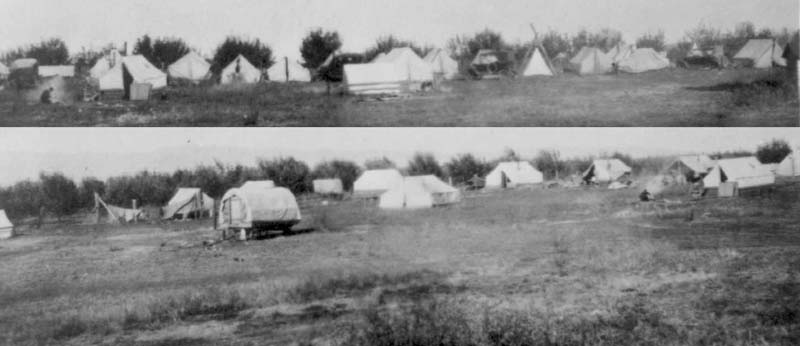
The early 1900s saw a remarkable fruit-growing boom in the Northwestern United States, driven by a mix of natural advantages, infrastructure expansion, and market demand.
William and Dora Black were ahead of their time when they established a commercial orchard about ten miles up Hornet Creek from Council in the 1880s. It must have been a challenge to market their crop, as transportation was limited to horses and wagons. It was a two-day wagon journey to Weiser, where there was a larger market and access to a railroad.
Communities in a number of areas around the Northwest had fertile, volcanic soil that was capable of producing bountiful crops, but they lacked two vital elements: irrigation water and a way to transport crops outside of a local market.
In the 1890s settlement in arid parts of the West motivated large-scale irrigation systems, with engineering innovations that included diversion dams, wooden flumes, and canal systems. New federal policies, including the 1902 Reclamation Act, helped make these big projects a reality.
By the early 1900s, railroads were expanding rapidly all over the western states. This, combined with ambitious irrigation projects, transformed arid areas like the Yakima, Wenatchee, and Okanogan Valleys in Central Washington into successful commercial fruit-producing centers. Apples, which had been grown locally since the 1820s, suddenly became a major export crop, nationally and internationally. Fruit-growing became a symbol of progress and prosperity. Investing in land where fruit was to be grown became very popular. Some such investments were legitimate; some not so much.
The increase in apple production was dramatic all over the Northwest. In addition to water and railroad factors, orchardists began adopting standardized tree spacing and new pruning styles. These changes improved sunlight penetration, air circulation, and access for new innovations in equipment. The U.S. Department of Agriculture and state agricultural experiment stations played a big role in promoting the best practices.
One of those experiment stations was established by the Forest Service in the spring of 1909 at the Stevens Ranger Station near the mouth of the East Fork of the Weiser River. Various fruit trees were grown to determine which varieties were best adapted for the local climate.
Selective breeding and variety standardization led to higher yields and better shelf life, but it also meant a dramatic reduction in fruit variety. Hundreds of heirloom apple types gave way to a handful of commercially viable ones like Baldwin, Ben Davis, and later, Red Delicious. Since 1900, about 6,000 known varieties of apples (86% of those ever on record) have become extinct.
The establishment of the orchards at Mesa was a direct product of the Northwestern fruit boom. After the arrival of the P&IN Railway at Council, the Weiser Valley Land & Water Company likely figured they would overcome the almost complete lack of irrigation water on their newly-acquired land at Mesa by doing what so many other fruit-growing areas had done – create an ambitious irrigation project of their own. The result was Lost Valley Reservoir and a seven-mile flume to carry water to the orchards.
In my presentation about Mesa Orchards at the New Meadows depot on the 24th, I didn’t explain very well that the creation of Lost Valley Reservoir enabled the orchard company to either sell rights to that stored water so they could buy water rights on the Middle Fork of the Weiser River or trade stored water rights for rights on the Middle Fork. Their water didn’t come directly from the reservoir, but via a flume from the Middle Fork.
In addition to the fruit boom, irrigation projects and railroad expansion boosted production of other crops and resulted in a shift toward larger farms and a need for seasonal labor, especially during planting and harvest. This led to more migrant workers and more specialized worker skills. This led to some interesting social changes.
On some large farms, harsh working conditions, low pay, and lack of housing or sanitation in labor camps led to early labor organizing efforts. Groups like the Industrial Workers of the World (IWW) were active in places like Yakima Valley, advocating for better treatment of farm workers as early as the 1910s. This didn’t seem to be a factor at Mesa. Much of their labor was sourced from the general area and provided very welcome income for many individuals and families.
Mesa Orchards may have been the largest orchard in the U.S. “under one management.” It may be that areas like the Yakama and Wenatchee Valleys survived the challenges that led to the demise of Mesa Orchards, at least partly because they were not under one management. Instead of a single operation, those areas became fruit-growing communities with a wider range of resources and support.
Also, irrigation didn’t depend on a single, expensive-to-maintain source (the flume). Indians of the Yakama tribe had been irrigating long before settlers arrived, using natural channels and developed water systems. Yakama Nation Farms – owned and operated by the Confederated Tribes and bands of the Yakama Nation – continues to be productive today.
Two major irrigation projects in the Yakima Valley, one expanded under the Bureau of Reclamation, and another project that was part of the Newlands Reclamation Act, stabilized seasonal water supplies. Ditches in the Wenatchee Valley and organization of the Wenatchee Irrigation District helped insure adequate water for orchards there.
100 years ago
July 24, 1925
A boy was born to Mr. and Mrs. Harry Adams on July 17.
A girl was born to Mr. and Mrs. Newt Hannamon of Brownlee July 18.
“The site upon which the S. & S. building once stood, but was destroyed by fire four years ago... is now being cleared and Clyde and Tom Linder will erect a service station on the corner.”
75 years ago
July 20, 1950
This issue contained the second part of an article, “Early History of Salubria Valley,” by Ila G. Wilson.
The Crane Creek area is experiencing a bad infestation of grasshoppers.
49 years ago
July 8, 1976
Died: Clara Allison, 72, formerly of Cambridge.
Shoepeg Grange members held a meeting July 1 with 19 members present.
25 years ago
July 13, 2000
New school building report: “The existing wall of the gym was not structurally sound enough to have a beam bolted to it and carry the load of the roof. This meant that a special beam and wall had to be installed to transfer the load of both the second floor and the roof to the gym existing foundation. All the exterior windows are in. The library, home ec room, and high school wing of the building now have most of their interior walls completed.”
Died: Lora Isabelle Biggs, 69, Council.
A new Idaho Power line is being built from Brownlee Dam to Paddock Reservoir east of Weiser, crossing Highway 95 at Midvale Hill.