
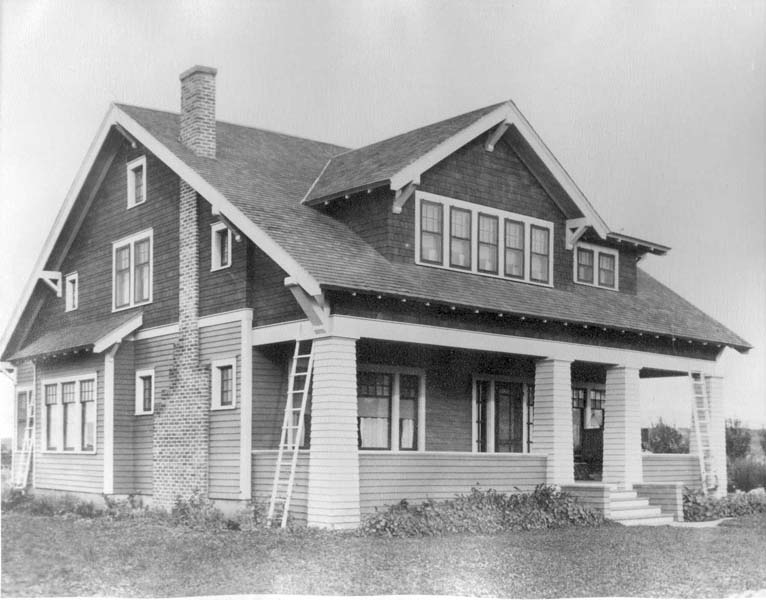
When Charles Seymour and David Van Hoesen arrived at Mesa, they almost literally hit the ground running. They immediately embarked on a building campaign. Calling it “ambitious” would be an understatement.
Myderse remembered:
“It was during this period, commencing in the spring of 1919, that an extensive building program was undertaken. The store and Post Office were greatly enlarged. Harry Mills, assisted by his good wife, Lyda, had complete management of the store during the entire Van Hoesen era at Mesa. My brother, Enderse, assisted by Lillian Pettit, a sister of Clyde Rush, was the postmaster. Lillian also did all of the book-keeping for the entire operation, including payroll records, and assisted in the store during rush hours.
“The packing house and fruit storage buildings were enlarged and the equipment modernized, and a separate warehouse for storage of orchard machinery and equipment was constructed. A well was drilled in the center of the townsite, after Bill Lynch, our head carpenter, located an underground stream with the use of a willow wand. A nearly adequate supply of excellent water for domestic purposes was obtained, and we thereafter enjoyed the luxury of good water under pressure, and no longer had to melt snow in the winter for cooking, washing and bathing.”
A 60’ X 100’ repair shop with a community center on the second floor was erected. The upper story had a hardwood floor and a stage. This was the scene of many dances, church services, movies and other social events. The houses that were built for Van Hoesen and Seymour seemed like mansions compared to the average local dwelling. Several smaller houses were erected for the year-around employees.
Mynderse: “In our early days at Mesa the Van Hoesen and Seymour wives, and later Mrs. Woodmansee conducted religious services each Sunday in the School House. The services were well attended in spite of the fact that usually there had been an all night dance with supper or breakfast in the dance hall above the garage, or a late movie with the hand operated moving picture machine. Bill Evans, who for many years drove his team of mules to Council and back every day except Sunday with the mail and supplies, used to occasionally bring movie films on Saturdays from the theater in Council. After running them we would put them on the early morning stage coach for delivery at Weiser. I don’t think anyone connected with the consignment knew that the films had been hi-jacked for showing in Mesa.
“During all of the Van Hoesen ‘era’ at Mesa there were a few ‘outside’ owners, most of them the original investors who had ‘stayed with the project’ and owned one, two or three ten acre tracts in the Orchards. These Orchard tracts were cared for and operated under contracts with the owners along with the balance of the Orchards under our management. In addition there were several ‘local’ owners who lived on their tracts and cared for them individually. Some of these were Clyde Rush, Gus Keckler, Peter Dahlgren, John DenBoer, H.L. Brooks, Stephen Nock, the Messingers, Ed Hart and perhaps one or two more.”
Tramway
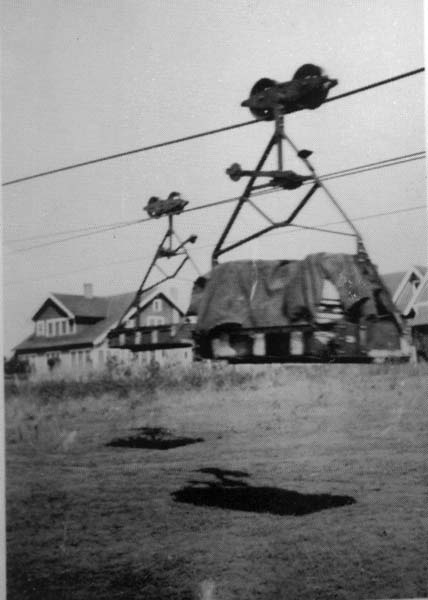
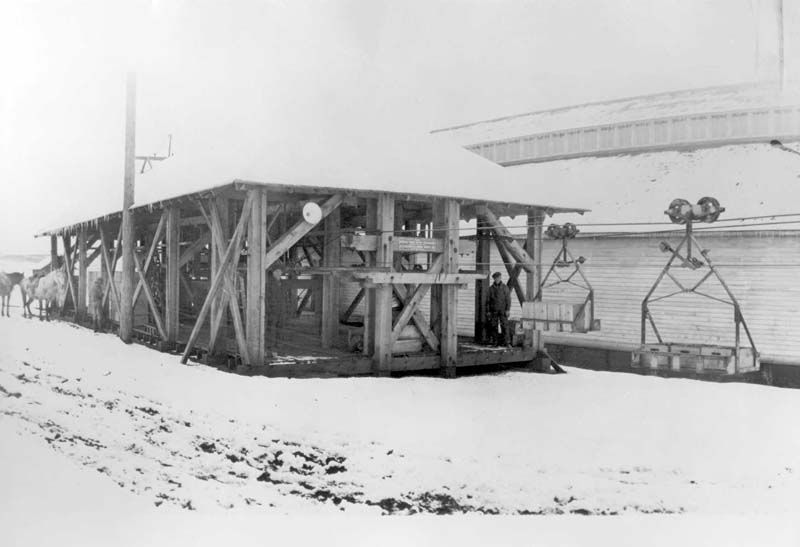
Mynderse: “One of the unique facilities conceived by my father, and constructed during this period, was the aerial tramway running from the packing house over the rolling country about three and one-half miles down to a new siding, ‘Mesa’, on the ‘Pin’ road where we also built a storage facility.
“While quite a tourist attraction, the tramway was an absolute necessity during those next few years. the roadway was almost impassable in the winter months when much of the fruit was shipped, even for the teams of horses and sleighs, and it was difficult to keep the fruit from freezing on the long haul to the siding. We could cover the tramway carriers with heavy water-proofed canvass which protected the boxes and baskets of fruit during the shorter trip from rain, cold, and sleet. Also the tramway could load cars at the siding twenty four hours a day without the resulting mix-up when one sleigh load of fruit would arrive out of sequence, and destined for a different car than the one being loaded.
‘The tramway received a lot of publicity. I recall a couple of fellows arriving at the Orchards one day and asking if they could inspect the tramway. It turned out they were from Honolulu and had been sent to Mesa by some Hawaiian Pineapple interests to ascertain if a tramway would be feasible to transport pineapples from the fields to the cannery. Incidentally, we thought they would be impressed when we told them we had about 1250 acres in fruit trees, but upon being asked their acreage they replied that the small area they were thinking about contained about 12,000 acres.”
Continued next week.


100 years ago
July 18, 1924
“Two young men were arrested at New Meadows the fourth for having liquor in their possession. Mark Winkler pled guilty, and the other man was discharged.”
“The 1924 Chautauqua drew a larger attendance than even the most optimistic had expected. It was generally agreed to pass up a Chautauqua next year. Council, who had the same Chautauqua this year, also refused to secure it for next. This fact will help toward making a fair next year a success, if undertaken. A strictly local fair it seems to many could be made a wonderful success if conditions are favorable at all next summer.”
These men gave their lives during WWI: Cambridge – Albert L Cox, Harry Madison, Earl E. Dugger and Dewey O. Thrall. Midvale – Ray W. Bunton, Wilbur Courtright, Alfred minor and Melven G. Wilson. Others from Washington County were listed.
75 years ago
July 21, 1949
The home of Mr. and Mrs. Charles Vogel was destroyed by fire Saturday afternoon.
Margaret Parke-Johnson, formerly of Cambridge, stopped at the news-reporter office and shared a memory. “Mrs. Johnson said she remembered that while the news-reporter office was being built, that an Indian made a bet that he could ride a certain horse without saddle or bridle. The ride started across the street from the new building and was climaxed by the horse bucking in through the center window of the north side of the shop, and continuing to buck right out the front door with the Indian sticking tight.”
49 years ago
July 24, 1975
Died: Dorothy L. Steelman, 56, at Caldwell. She married Clarence Steelman in 1941. They Moved to Council where they lived for 25 years before moving to Caldwell in 1971.
Died: Kathyrn Donart Estes, 79, of Kennewick, Washington. She was born in Salubria in 1896. In 1913 she married Ernest Estes in Salubria. They moved to Portland Oregon in 1913 and to Kennewick in 1938.
A son named Michael Eugene was born to Mr. and Mrs. Philip Horton July 19 at Weiser.
Died: Arlin McCullen Merrick, 74, of California, formerly of Midvale. He was born in 1901 in Washington and was owner and operator of the Highway Inn and Bar at Midvale from 1962 to 1968.
Members of the Upper Country Grange will remodel to have the ceiling of their hall lowered after the roof was damaged by wind.
Married: Barbara Sutton, daughter of Mr. and Mrs. Wayne Sutton of Midvale, and Mark Wimer of Cottonwood.
25 years ago
July 22, 1999
Died: Carlos R. Tucker, 90, at Weiser. He was born at Indian Valley in 1909 to Robert and Anna Tucker. He moved to Payette in 1944 where he farmed until he retired in 1976.
Died: Helen Josephine (Meyer) Lortz, 80, of Fruitvale. She was born in North Dakota in 1918 and married Charles (Chuck) Lortz in 1939. Upon their retirement in 1973, Helen and Chuck moved to Fruitvale where they owned and operated Starkey Hot Springs.