
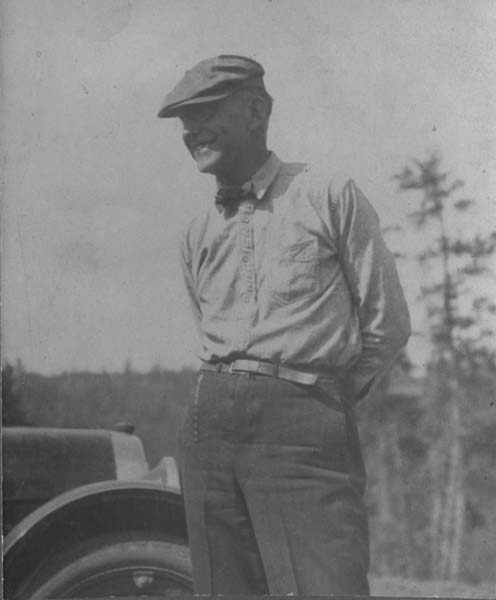
By 1920 many families owned automobiles, and people and goods traveled faster and farther. As a result, noxious weeds and crop-damaging insects and diseases began hitch-hiking into the area. My father, Dick Fisk (born 1913) remembered when earwigs appeared here.
By 1920 the blister mite, one of the worst enemies of fruit growers of that time, had appeared in orchards at Council and Mesa. The decade of the 1920s would also see an agricultural depression, caused in part by market repercussions of WWI. How it affected Mesa Orchards is not clear.
The May 7, 1920 Adams County Leader said a well had just been drilled at Mesa, which the paper said was the first step in constructing a pressure water system at Mesa.
The October 2 issue of the Leader said: “A dance is announced to be held at Mesa this Friday night. the price of tickets will be $1.00 including war tax.” The dance was probably held in the hall over the machine shop. Also advertised, Van Hoesen & Seymour were selling Bartlett pears for seven cents per pound at Mesa.
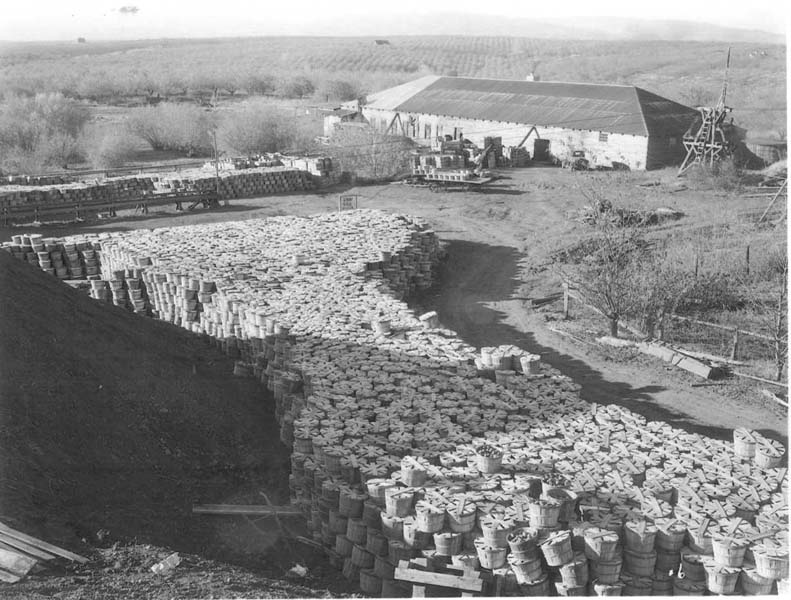
The Mesa tramway was probably finished in 1920. Before that, fruit that was shipped by rail was taken by wagons to a railroad siding at “Vista,” which was located near where Cottonwood Road now meets Highway 95. The tramway reached the tracks at a new siding and buildings where the rails turned north, just south of Cottonwood Creek. The tramway is said to have cost $45,000 (over $700,000 in today’s dollars). It was supported by 48 wooden towers which varied in height from 20 to 45 feet. Each of its 42 steel baskets carried six to eight boxes of fruit. The tramway was equipped with its own telephone system, and could deliver four packed boxes of apples a minute. Charlie Winkler claimed much of the tramway cable used at the Mesa Orchards came from the Black Lake tramway. I have to wonder about the validity of that claim.
Adams County Leader, Oct 29, 1920: A Mesa employee was seriously injured while driving a team under the tramway. The cable hit his head, opening a three-inch gash.
In election of November 1920 Mesa precinct voters chose store manager Harry Mills as their Constable.
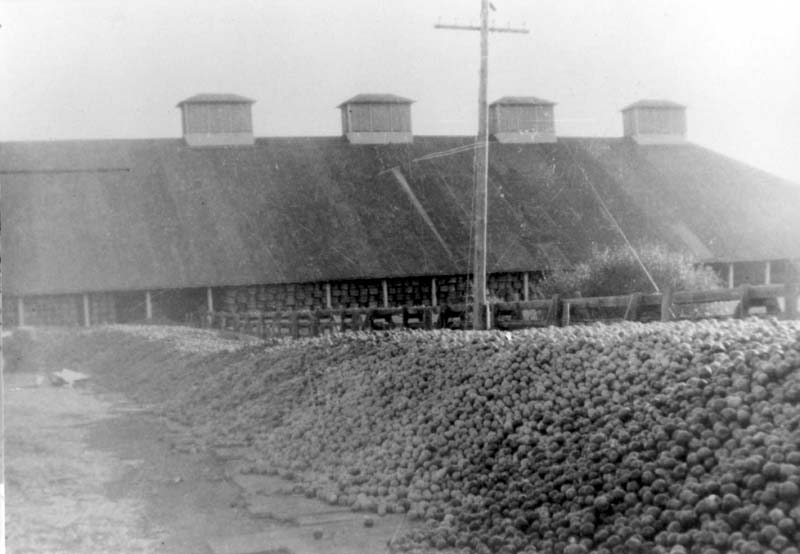
1920 was a good year for Mesa Orchards – until it wasn’t. A big, new packing house was completed that was said to be “one of the largest and best equipped in the entire Northwest.” It had been completed in time to store most of the year’s apple harvest.
On the evening of December 18, just a week before Christmas, panic gripped the community when someone noticed the new packing house was on fire!
It would have been dark, or nearly dark, very early at this time of year, so the fire would have been visible for miles in all directions and lit up the night sky.
Charles Seymour and Shorty Mulvihill grabbed a chemical fire extinguisher and ran into the burning structure.
The Cambridge newspaper reported: “As they Seymour and Milvihill were gone longer than the others thought they ought to be, a searching party was organized and entered the burning building in the hope of finding them. Mulvihill was found lying on the floor, overcome with smoke fumes and was rescued, but all efforts to find Mr. Seymour were futile and the intensity of the heat finally forced the searchers to give up.”
Around 8:30 p.m., one side of the building collapsed. As the huge section of the roof came crashing down, charred and burning parts of the big building exploded across the nearby ground. To the horror of onlookers, among the scattered debris was the partially-burned body of Charles Seymour.
The loss of the co-owner and general manager of the Mesa Orchards Company, and the horrific way in which it happened, was a stunning blow. Charles Seymour was 47 years old and left a wife, Maude, and 14-year-old son, Alec. His body was shipped back to his hometown of Cortland, New York for burial.
Continued next week.
I’d like know if anyone knows whether fox farmers in the Meadows Valley area years ago ground up the carcasses of the foxes that they had skinned. And whether they then fed those ground up foxes to the foxes being raised. This sounds a little far fetched to me, but please contact me if you have some info on this.
100 years ago
August 1, 1924
A “mass meeting” will be held at Weiser. The first thing discussed will be “a plan to refinance farmers who are temporarily embarrassed through the closing of the Weiser National Bank in particular and the agricultural slump in general.” Senator Borah will be there. Midvale and Cambridge will send large delegations.
“The tourists auto park has been used a great deal the past weeks. The large number who habitually use the highway and campgrounds has given the park the appearance of a veritable village of tents at times.”
“The Shropshire sawmill on Hitt mountain closed down last week..”
“A spark from the engine of a P. & I. N. train caught fire in the weeds between milepost 23 and 26. The fire spread so rapidly that the section crew could not put it out.” So far, the fire has burned between 2000 and 3000 acres and is still burning.
75 years ago
August 4, 1949
Died at the Council hospital Friday evening: Alexander (Alex) Allison, Salubria Valley rancher and one of the few remaining native pioneers of this section. He was born in 1875 on the ranch near Cambridge, which was his home for his entire life. He married Martha Abernathy in 1894.
A son was born August 3 to Mr. and Mrs. Delbert Ware at St. Luke’s hospital in Boise.
A daughter named Peggy Fern was born to Mr. and Mrs. Kenneth Williams July 29 at the Council hospital.
“Public meetings will be held at Cambridge and Midvale to help the people of the upper country decide whether or not the Columbia Valley Authority is desirous.”
Midvale – “There are now 14 students enrolled in the C. A. A. flight training under the G.I. bill at the local airport.”
Indian Valley – “Carpenters started work on the Congregational Church Tuesday. Work is progressing nicely, even though unexpected difficulty was encountered with the wall and chimney.”
49 Years ago
August 7, 1975
The Forest Service is issuing free permits to cut firewood. “The only stipulation on the free use is that the wood cannot be sold.”
Demand on the Cambridge water system has been so heavy that the 30 hp pump has been overworked. It will be replaced by a 40 hp pump. Cambridge water users are asked not to irrigate between the hours of 1:00 and 3:00 p.m. during the balance of the week, or at any time when temperatures top 90 degrees.
A daughter was born to Mr. and Mrs. Gary Richel at the Weiser hospital.
Married at Indian Valley June 21: Cindy Lou Shaw, daughter of Mr. and Mrs. Earl Shaw of Indian Valley, and Nicholas Lee Hylton son of Rev. and Mrs. Lee Hylton of Emmett.
Married at Indian Valley June 28: Rebecca Arlene Shaw, daughter of Mr. and Mrs. Earl Shaw of Indian Valley, and Ronnie Clifford Smith of Council.
25 years ago
August 5, 1999
Died: Lyle P. Harrington, 88, of Council. He was born in 1911 at the Homestead of his parents, Robert and Lily Montgomery Harrington 12 miles north of Council on North Hornet Creek. He was the 13th child of 16 children. He married Doris Byers of Indian Valley in 1939.
Public notice: “The County Commissioners are interested in receiving written comments from the citizens of Washington County concerning health, safety, and general welfare regulations on the trail corridor previously operated by Union Pacific Railroad and now rail banked with the group known as Friends of the Weiser River Trail. Recent opinions by the County Attorney, the Attorney General, and the federal court have led us to believe that current county zoning ordinances do not provide a means by which the trail can be regulated. However, we are also of the opinion that both trail proponents and opponents would like to see reasonable regulations applied to the core door.”