
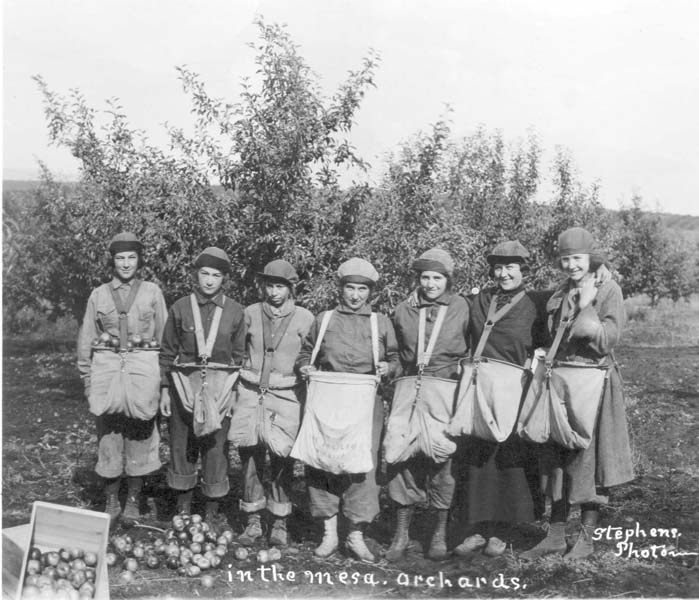
During the early days of the Depression, the Mesa Orchards seemed to be doing well, at least on the surface.
Enderse Van Hoesen, as secretary of the company, filed a document in September 1933 stating that the company’s total acreages growing fruit contained approximately 1,000 acres of apples, 30 acres of peaches and 20 acres of pears. He said the sales of fruit during the years 1921 to 1932 was $150.04 per acre. They also sold about 400 tons of hay each year. They took in about $5,000 per year by renting out buildings. Enderse said the 1933 crop “is the largest crop ever produced on the Mesa Orchard.”
In December 1933 an article about Mesa orchards titled, “The World’s Largest Apple Orchard” appeared in the Statesman newspaper. The following is either directly quoted or paraphrased from that article.
The company owns and operates 1,200 acres of orchard and an additional 1,600 acres of pasture and hay land. A woven wire fence, 12 miles in length, surrounds the property.
The land is irrigated by gravity, being distributed from the mouth of the flume through underground pipes.
The tramway has 42 carriers, each with a capacity of six baskets or eight boxes of apples. A carrier leaves Mesa every minute and a half and it requires 30 minutes to reach the loading station at the railway. 660 baskets, enough for a carload, pass over the 3.6 miles every three hours. In bad weather, covers are placed over the carriers as a protection to the fruit. The aerial tramway leads to a private switch of the company’s alongside the railroad. Here is located a second storage house with a capacity of more than 10,000 packed baskets of apples
This year, in order to store a part of the orchards output for later marketing, two earth storages were built, which are the largest of their kind in the United States. Dredges were used to scoop out the earth in their construction. Each storage is 75 feet wide, 150 feet long and 25 feet high. Or baskets of loose fruit can be stored in the two cellars. This is approximately 23 million apples, or enough for an apple a day for every person in Idaho for more than a month and a half.
The Mesa Orchard Company employed more than 500 persons to harvest the 1933 crop of apples. There were 13 crews of pickers with about 20 to the crew, and a foreman in charge of each. Between 15,000 and 20,000 boxes of apples were picked by each crew during the season, which started in September and ended the first week in November. To bring fruit out of the orchard required 150 head of horses and 18 trucks. A total of 20 carloads of empty baskets – approximately 172,000 baskets – were shipped in this year for use at the orchard.
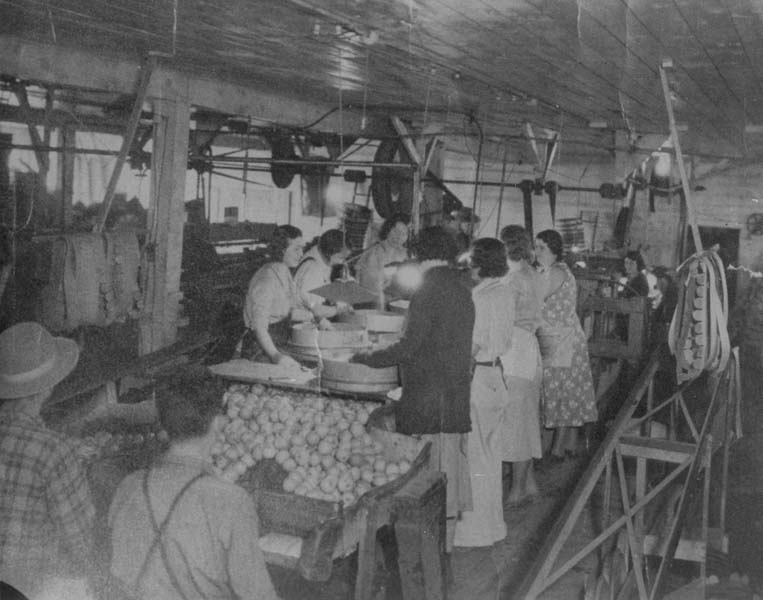
There are three two-story houses occupied by officers, 9 four-room and seven two-room bungalows and numerous other smaller buildings for employees. The buildings are all situated on the townsite of the company. Mesa also includes the company’s boardinghouse, town hall, men’s dormitory, the county public school building and a garage and repair shop where all the companies machinery is overhauled and repaired. In addition, the company owns a two-story air-cooled storage house with a capacity of 100,000 loose boxes of fruit. Connected with this is the packing house and sorting room. There is also a dehydrator, in itself no small building.
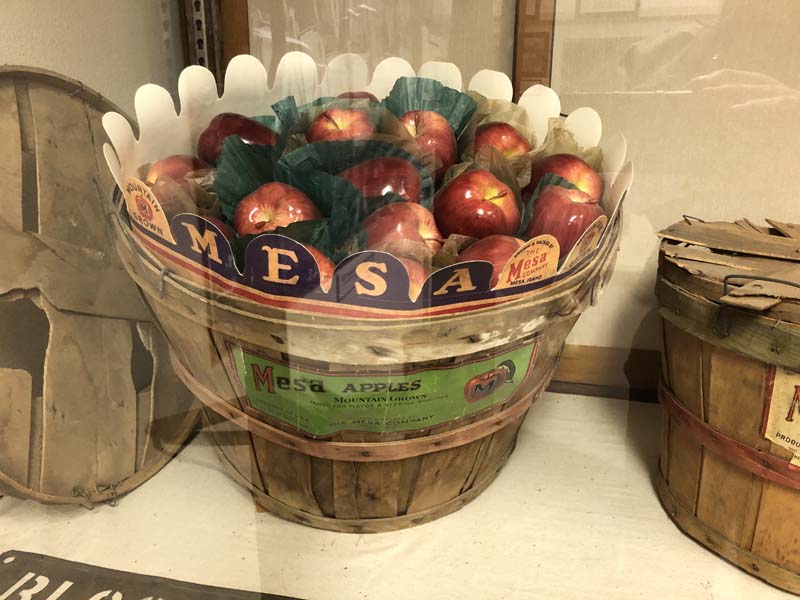
The company annually ships to England, Sweden, Germany and Norway The Big M brand, which appears on all fruit shipped, has even appeared in Alexandria, Egypt
End of article.
About two months after the Statesman’s article came out, the company issued a “ Statement of Cost of Production” in February 1934:
Packing materials = $30, 325. Picking $11,892. Spraying $11,639. Barn and Team expense = $2,124. Truck and Tractor expense = $984. Water Assessment = $3,555. Net Cost of Production = $101,895.
Land: Orchard = 875 acres. Farm land = 1,297 acres. Pasture land = 714 acres. Townsite = 20 acres. “Cut Over Land” = 320 acres. Total land value: $510,299. Tramway valued at $45,000. Buildings valued at $102,712.
By this time the flume was showing its age and the company was contemplating rebuilding it. Cost estimates ranged from $38,680 to $48,214. These estimates would prove to be significantly low.
The public face of the Mesa Orchards Company exhibited only optimism. But the company ship had already hit an iceberg.
Next week: Saving a sinking financial ship.
100 years ago
September 19, 1924
“A representative of the Steunenberg Memorial Association was here last week, soliciting funds to complete the proposed monument. It is planned by the association to erect a life-size bronze statue facing the capital building at Boise in honor of Idaho’s first martyr. The cost is to be $35,000. The legislature in 1917 appropriated $15,000 for this purpose and private contributions are expected to raise the remaining $20,000.”
Died: Julia Kester, age 2 years and 10 months, the daughter of Mr. and Mrs. Frederick Kester of Rush Creek. Death was due to intestinal trouble. Burial in the Cambridge Cemetery.
75 years ago
September 22, 1949
Died: Edmund D. Kilborn. He was born in Oregon in 1865 and came to Middle Valley with his father and older brother by team and wagon in 1879. During his 70 years in Middle Valley he was engaged in farming and stock raising.
49 years ago
September 18, 1975
The wedding of Stephen N. Ritter and Brenda L. Barton is set for September 20 in Cambridge.
A son named Pike Robert was born August 3 to Mr. and Mrs. Jay Langer.
“The Idaho Cattlemen’s Association is posting a reward of up to $1000 or information leading to the arrest and conviction of cattle rustlers or anyone who kills or mutilates stock illegally.”
25 years ago
September 16, 1999
Died: Floy Isla Buhl Hansen, 85. She was born in 1914 at Cambridge.
An open letter to the Adams County Commissioners expressed concerns about the Weiser River Trail involving: harassment of livestock/wildlife, liability insurance, fires, unleashed dogs on the trail, weed management, rest room facilities and maintenance, trash cans, and more. “It is our belief that the trail will have a negative impact on the Weiser watershed, wildlife habitat and migration routes, as well as the adjoining landowners. Law enforcement and emergency medical services may also be significantly hampered by the implementation of this project. Despite the issues that we have addressed, there remains a strong possibility of injury to a trail user which could involve Adams County right of way, land owners and FWRT in litigation.”