
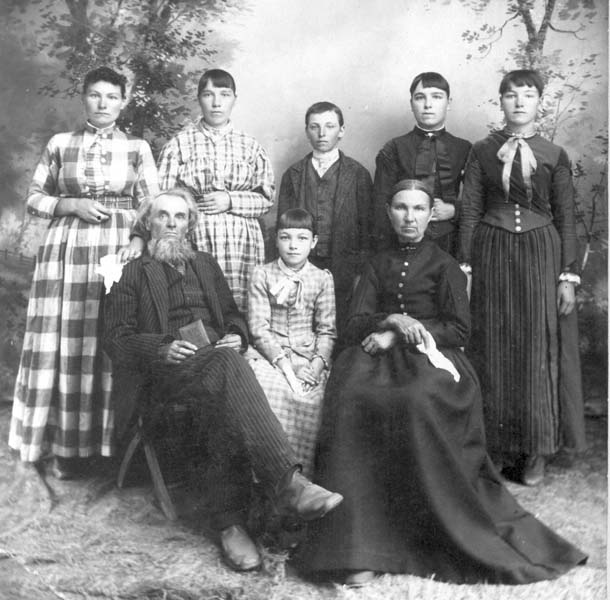
Raising hogs led to a painful incident for George Moser. It was quite common during the early settlement of the valleys along the Weiser River for farmers to have problems with bears killing livestock, especially pigs. In 1882, George Moser and some other men pursued a bear that had been killing Moser’s pigs.
Matilda Moser wrote: “Among the ‘adventures’ Mr. Moser had during those early years in Council was one with a bear. This big bear had been annoying the neighborhood by killing pigs. Finally three or four men with guns and dogs went out to track the bear. Mr. Moser, going along a trail and stooping to avoid overhanging branches, came to a dry creek. As he reached the creek bed, the bear, angered by the dog, suddenly appeared and lunged down the opposite bank. Before the hunter could aim his gun the bear was upon him, snarling and biting. A clump of willows in the creek bed offered some protection.”
George’s wounds from this attack were serious. The bear tore significant chunks of flesh from his legs.
Weiser City Leader, Nov 4, 1882 – “George Moser is still recovering from wounds to his leg which he suffered in an attack by a grizzly bear some time ago. He is not expected to be able to walk for another month or more.
George recovered, but the wounds bothered him the rest of his life.
As you can see, some reports say that the bear that attacked Moser was a grizzly, but this has not been confirmed. (The museum has a few claws that are said to be from this bear, and they do look like grizzly claws.) Early reports of bear incidents were not usually clear as to the species of the bear. People in those days seemed inclined to exaggerate and over-dramatize just about any aspect of life, so some stories about grizzly bears probably really involved black bears. There probably were a few grizzlies in the Council area. The abundant salmon in the Weiser River would have been an ideal food source for them.
Matilda Moser wrote about what their lives were like in those early days:
“The garden provided most kinds of vegetables, and always a patch of watermelons was included. Dried corn was used for hominy or corn bread; and for winter evenings popcorn or parched corn was a treat. My father was fond of “crunchy” foods, and occasionally he browned thin slices of potatoes in a Dutch Oven set over a bed of coals or in a long-handled frying pan.
“Lye was used in preparing corn for hominy, and for this purpose a lye kiln was built in the rear yard. The kiln was filled with ashes, and water poured over the ashes filtered down into a trough which emptied it into a pail placed at the lower end. Lye was also used in making soap.
Sauerkraut was made in a barrel. A spade, cleaned and sharpened, was used to chop the cabbage to tiny pieces. Salt was then added and the barrel covered and set aside for cabbage to ‘sour.’
“Turnips, carrots, etc., were gathered and piled in heaps and covered with earth to protect them from freezing, and removed from the pit as needed
“During the first ten years or more here only green coffee was obtainable. It was carefully browned in the kitchen oven and ground as needed in a grinder fastened to the wall. Later a boxlike grinder, which could be held on the knees, was operated by turning the handle round and round.
“As soon as lumber could be procured, my father built a milkhouse, covered it with rustic, and lined it with shiplap. A row of shelves was made to hold the many shiny tin pans into which the strained fresh milk was poured. Mother churned often, as we used much butter and there was a ready market for any surplus. For years the regular price was 25 cents per pound for butter and 5 cents per quart for milk or buttermilk.
“Deep snow in winter and colder weather than now was the rule. Mother had a spinning wheel and spun both cotton and wool thread from which socks, stockings, mittens, wristlets, and neck scarfs were made. However, before the spinning, cards were used to make the wool or cotton into small rolls 12 to 15 inches long. As no one had overshoes at that time, the wool hose were much needed in winter. Some men used ‘gunny sacks’ to bind about their feet and legs when doing outside work, but many suffered from chilblains before rubber boots and overshoes came into use.
“Four days was the usual time required for a trip to Weiser and return. Travelers on the Council-Hornet Creek road crossed the river in a small boat. This was hazardous in early spring when the ice broke up and the river overflowed its banks at some places. One such place was on the east side of town where there was a slough beginning a little north of the present bridge and extending south some distance. One man lost his life while trying to cross the river by boat.”
Continued next week.
100 years ago
April 11, 1924
“Miss Isla Buhl is acting as operator at the Indian Valley Telephone Co. office here for a short time.”
“At a meeting of the village trustees Tuesday evening it was voted to fence the city park in Cambridge. Quite a number of young trees were set out last year, and stock must be kept out if they are to do any good. The fence will be woven wire with four strands of barb wire above. Cedar posts will be used, set about 10 feet apart.”
Samuel M. C. Reynolds died last Sunday at the Idaho State Soldiers Home at the age of 77. Reynolds was the founder of the Idaho Citizen newspaper at Salubria in 1889, the second oldest newspaper in Washington County. The News-Reporter is the descendant of the Idaho Citizen.
“A baby boy was born to Mr. and Mrs. Brown April 9 at the home of Prof. and Mrs. T. C. Woods.”
Died: Mrs. Dave Eva Pfenning of Emmett, formerly of Midvale.
75 years ago
April 14, 1949
Emerson Wheeler purchased Mrs. Mackey Wheeler’s share of the Midvale Market. Mr. and Mrs. Emerson Wheeler and Mr. and Mrs. Vernon McClure are now owners of the market.”
Married at Winnemucca: J. L. Stokes and Mrs. Elsie M. Berry.
“The community was shocked and saddened Friday morning when they learned of the death of Dr. A. S. Thurston. A large number from here attended his funeral at Council Monday.”
Obituary of Dr. Alvin S. Thurston, 51. He died from a heart attack Thursday night in his sleep at his home in Council. Dr. Thurston had delivered an address at a meeting of the Parents-Teacher Association a few hours before his death. He had been in ill health for some time. He had practiced in Council since June, 1931, moving there from Denver, Colorado. He was born in 1898 in Illinois. A veteran of World War I, Dr. Thurston was a member of the Council American Legion Post. His remains were sent to Portland for cremation. His ashes were later scattered over the Council Valley via airplane.
49 years ago
April 17, 1975
Midvale – “The Cancer Drive is now in this area for the month of April.”
25 years ago
April 22, 1999
Jim and Dee Hill will celebrate their 50th wedding anniversary on May 7.
The bike-a-thon to benefit the Midvale swimming pool will be this Saturday.