
It didn’t take many years into the 1880s before the choice locations in the Council Valley were claimed. Early settlers who arrived in the late 1870s, like the Mosers, Keslers and Winklers, took some of the best farm ground. By 1888 the Weiser newspaper said the Council Valley “is now cultivated clear up to the timbered foothills.”
In 1886 Emily Moser married Miles Bramblee (1858 – 1936). They eventually had 5 children.
An 1886-’87 business directory listed various communities, their amenities and the people who operated businesses there. It said, “Council Valley. It contains a brewery, sulky rake, plow, wheat fan and washing machine factories and several stores. Ships grain and produce. Population, 300. Mail, weekly.” Anderson Moser was listed as a wheat fan manufacturer and George Moser was listed as a carpenter. How accurate all this was is open to speculation, especially the mention of factories.
Idaho Citizen, Nov 6, 1891: Moser’s new house nearing completion at Council.
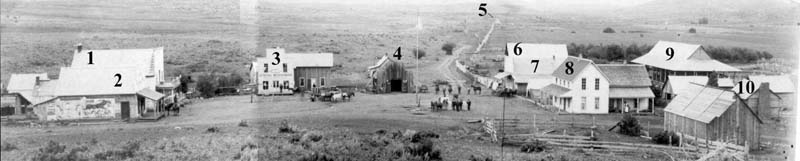
In 1891 the Moser family found their log cabins inadequate to serve both as home and boarding house. In the fall of 1891 they finished a larger, frame structure to serve the same home / hotel purpose. This two-story building, known as the “Moser Hotel,” was erected just east of their old cabins, and across the street west of what would become the town square.
It was about this time that what is now the town of Council began to take form at its present location. A school and John Peter’s store had been established about a mile north of the present town, along present-day Galena Street. The establishment of a town at the present site may have been instigated by a gift of land by George Moser. It is said that Moser donated a piece of ground just east of his house for a town square because he didn’t want just a narrow street in front of his home. Such squares were a popular feature in small towns all over the U.S. at this time. Moser evidently sold portions of his homestead around the edges of the proposed town square, as businesses soon started sprouting up there.
In the spring of 1894 George Moser took a journey back to his old home near Hot Springs, Arkansas. His trip was motivated in large part by his ill health, and the hot springs offered some help in this regard. Shortly after arriving in Arkansas, George died on March14 at the age of about 64. I have not been able to find where he was buried.
After the 1894 death of her husband, Elizabeth Moser started selling off more pieces of her homestead. The part of Council that the Mosers owned is the “Moser Division” today. Moser Avenue was spelled “Mosher” Avenue on the original plat of the town, and this mistake was perpetuated on maps and street signs for almost 100 years. Elizabeth Moser didn’t notice the misspelling because she was illiterate. She signed documents settling George’s estate with an “X”.
“Mosher” is said to be an old Jewish spelling of the name, and the engineer who drew the map may have only known of that spelling. It is obvious that the Avenue was named after the Moser family, and their name has never been spelled “Mosher” on any legal document, newspaper or public record. [Thankfully, the city has changed the street sign to the correct spelling, and a number of businesses on Moser Avenue now use the correct spelling. (I like to think the correction was finally made due to my constant nagging about the misspelling in this column. The same can be said for McMahan Lane at Fruitvale, which for years was misspelled “McMahon.”)
At some point Elizabeth Moser found herself deeply in debt. Maybe it was from construction of the Moser Hotel. The family struggled from this debt for some time. Matilda later wrote: “When the time arrived to pay the mortgage, a sufficient number of cattle were sold to make the payment and pay off some other indebtedness, although the price for 3-year-old steers was $16.00 per head and for cows $12.00 per head. When the Release of Mortgage was received from the Mortgage Company our family had a day of rejoicing. Mother never mentioned her own self denial; and I have ever felt that her example of courage and loyalty to her family was of far more worth than any material gifts.”
Whether it was to pay off debt or not is unclear, but over the years, Elizabeth sold parts of the Moser homestead. These lots became the west part of present-day Council.
Continued next week.
100 years ago
April 18, 1924
Died: Nora Holbrook Tidell, wife of James Tidell, at her home 5 miles west on Pine Creek. Internment in the Cambridge Cemetery.
The Commercial Club and the American Legion are “devising means to mark and protect the grave of the first white person in Salubria Valley. This grave is situated on what is now the H. A. Flory ranch, and dates back to 1862.” Martha Roberts, age 18, was a member of the Tim Goodale wagon train. “Before her death she had chosen the knoll near the home of their to them in Adams, who cared for the grave during his lifetime. Harrison Abernathy, father of Mrs. Alex Allison, was in this party and He and Uncle Johnny Moore later returned to the Valley to live.”
Died at Weiser: Mrs. Agnes Bradshaw, formerly of Cambridge. Burial in the Cambridge Cemetery. Her husband, who was in business in Cambridge, died in 1917.”
“A. A. Davidson of Boise gave a lecture on Americanism, in the interest of the Ku Klux Klan, to a large crowd of men at the I. O. O. F. Hall Saturday evening.”
Obituary of Eva G. Pfenning, born Eva Doggett in Washington in 1895.
75 years ago
April 21, 1949
Died at the Boise: James Bryant, 63, formerly of Cambridge and an Ada County Deputy Sheriff since 1942.
A girl was born to Mr. and Mrs. Harold Ball of Alpine.
49 years ago
April 24, 1975
Died: Ruben Lawrence George, 82 of Fruitland, formerly of Indian Valley. Born in California in 1893, he moved to a ranch at Indian Valley in 1949 and moved to Fruitland in 1962. He married Alice Cary Davis in 1970 at Payette. Cary Davis George authored the book “Listen! The Pine Trees are Singing.”
An old Salubria Valley landmark, the one time pretentious residence built by the Doug Westerns, but more recently spoken of as the Whittle ranch house in the Cove section, was demolished and burned. “The house, built in about 1888 or ‘89, fronted the road which at that time was the main road connecting pioneer towns of Goodrich and Salubria.”
25 years ago
April 29, 1999
Larry and Kaye York moved into their new home on the corner of Cemetery Road.
“Some preliminary work will begin this week in Weiser in preparation for the Weiser Bridge Replacement Project, the Idaho Transportation Department announced. The project will replace the existing Weiser River bridge with a four-lane bridge including a turn lane sidewalks and bike paths on both sides.”
Engaged: Sabrina Marie Krob, daughter of Melvin and the Kim Wiggins of Cambridge, to Daryn Young of Weiser.
“A safety enhancement project to flatten nearby slopes to prevent rock from falling onto the roadway is underway on US 95 at Fort Hall Hill north of Council.”