
After writing about the recent past (some of us think of the 1990s as just yesterday) I thought I would go back to some of the earliest days of settlement in our area.
Boise started as a community just after the 1862 gold strikes in the Boise Basin. The Boise News started publication in 1863 – the same year Boise became an official town – and it was Idaho Territory’s first newspaper. The next year, the Idaho Tri-Weekly Statesman was first published. It began operation in a log cabin located on what is now the site of Boise City Hall. This newspaper later evolved into the Idaho Statesman, which remains Boise’s primary daily newspaper today.
By 1868 a few homesteads had been started in the Salubria and Indian Valleys. In 1876 the Tri-Weekly Statesman’s editor, Milton Kelly, took a trip through the Weiser River valleys and wrote a report on what he found.
Kelly set out around the first of June 1876 and reached the Salubria Valley on the 2nd. To put this time frame into context, later that month Custer would meet his demise at the Little Big Horn. And the next two years would see the biggest conflicts with native peoples in Idaho: the Nez Perce War (1877) and Bannock War (1878).
Kelly’s report starts: “The Weiser river has four separate valleys and consequently, four distinct neighborhoods, or settlements.” He had previously described the Weiser and Middle Valley areas and was now at Salubria Valley.
Kelly continued: “We now come to the third, or upper valley. The other valley (Indian Valley) which lies ten miles above this valley is on the Little Weiser river, and although really one of the valleys of the Weiser, is called Indian valley, from the fact that a small band of Indians have always lived there.
“The Weiser river, however, divides the Snake and Payette range, forming a low pass where may be observed an old Indian trail traveled by the Nez Perce Indians hundreds of years ago, and up to the time of the settlement of this Territory, in passing from the Salmon river this way to Snake river, which took them through what is now known as the Brownlee pass. The mail now travels over this old Indian trail, or pass in the mountains. (Modern day Highway 71.)
“This (Salubria) valley is about seven miles long and four miles wide. The main Weiser river runs on the north side of the valley and the Little Weiser on the south side, emptying into the main river at the foot, or lower end of the valley. The main body of the farming land and ranches lie between the two rivers; although some good farming land and several ranches are on the opposite side of these rivers. By the surveys neither of the streams are meandered; so that some farms lie on both sides of the river.
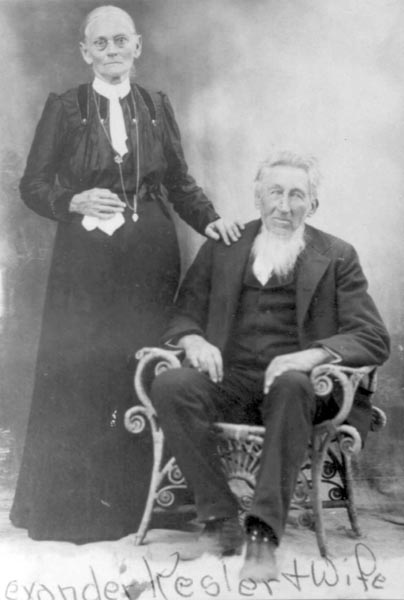
“Pine and Rush creeks empty into the main Weiser from the north; otherwise there are no other streams in the valley. There are thirty-two ranches, or farms, located in this valley, to-wit: Burrell Decker, Conrad Grab, John D. Wade, Peter Conrad, Peter Olson, Wm. Clymo, Owen Vandyke, John Holmes, Chris Lawson, Ike Powell, John Cuddy, Samuel Denny, John McRoberts, David Allison, II. and A. Abernathy, Alex Boyles, Alex Allison, Mrs. Pence, James Colston, Wm. Allison, John West, A. Jewell, Ed Jewell, Frank and Andrew Adams, Herman Lobel, Elizabeth Thompson, G.W. Philips, Wilkerson & Bros., A.J. Borland, Frank M. Mickey, N.S. Star and Alex Kesler.” (Alex Kesler and family would soon move on to the Council Valley.)
“Many of these ranches have lately been located and have no improvements, save a small cabin. Others have only added a garden patch, while some have a comfortable beginning, and a few have opened large farms and are well fixed. Their is still room for several more favorable locations on Government Land. The soil is deep, and a great portion of it is rich as a barnyard.
“All kinds of vegetables grow in great abundance if only put into the ground. The snow falls from one to two feet deep in the winter and generally lies on three months, but the weather is not very cold, with no wind. When roads are broken through the snow they are easily kept open.”
This assessment of the climate, like much of Kelly’s glowing descriptions, are a little over the top. If the winters were so mild, how did people cut thick slabs of ice from rivers and ponds?
“The summers are as lovely as those here could wish, and the valley is as healthy as ever the sun shone upon. Among the well improved farms that we noticed is Conrad Grab’s near the mouth of Pine creek. Mr. Grab formerly carried on a boot and shoe business in Boise City, but finally turned farmer in this valley. He is farming on what many would call a small scale, because he tills only 50 or 60 acres of land, but he told us that he raised 1,200 bushels of grain last year, and 10,000 pounds of potatoes, 1,500 pounds of beans, and a large quantity of roots and other vegetables; fattens his own pork and makes considerable butter to spare. He sold his beans at nine cents a pound in the (Boise) Basin, and the incoming immigration took all his other stuff at a good round price.
“Peter Olson, who lives next, above Mr. Grab, has comfortable buildings; he has not cultivated much land. He has over 100 head of cattle and some fine horses. He sold his place last week to David Bridgeman. Olson is going to locate on Hornet creek, a fine valley of land on a tributary of the Weiser, where there are no settlers.” (If he did move there, it would be news to me. The Mosers would be the first family to arrive in Council Valley that October.)
“Harrison and Andrew Abernathy located what is known as the Warm Spring ranch pretty well up the valley, in the fall of 1868. Here are large boiling springs, which come up out of the bottom of the Weiser, mingling the hot and cool waters together as they pass off down the river.
Continued next week.
100 years ago
October 1, 1925
The C. & H. Service station was destroyed by fire early this morning. No damage was done to the adjoining Hopper building. The building was practically new, having been running but a few months.
The yield at Mesa is excellent this year. “Several carloads are going out every day, and they are working to capacity to fill orders and get shipments underway. During the heavy shipments passenger service has been somewhat crippled. In order to move the fruit it was necessary for the railroad company to commandeer the passenger train to set and hauled back to Weiser, several cars each day.”
Married: Miss Ruth Buchanan and Mr. Hix Randleman.
A son was born to Mr. and Mrs. Oliver Skeen of Indian Valley, September 24.
Indian Valley: “Tilford Lindsay left his three-year-old son, Wilson, in the wagon on the seat while he ran into the store for a minute. The team became frightened and ran away. When near the Congregational Church, they struck a telephone pole and broke loose from the rig. The little fellow was still clinging to the seat, unharmed but much frightened.”
Advertisement: “Dance at Mesa Orchards – Saturday, October 3 – Five Piece Orchestra – Dancing at 8:30 – Special Banjo Duet – Mesa Civic Club”
75 years ago
Issue skipped in order to catch up.
49 years ago
September 16, 1976
Back on May 19 one-and-a-half-year-old Benjamin, the son of Mr. and Mrs. Ferrel Crossley of Goodrich was sitting on the railroad track near his home as the train approached, traveling at 20 mph and towing 18 empties and a caboose, for a total of 670 tons. Engineer Harold Lane and student engineer Randy Anderson saw the child when the train was only 175 feet away from the child. Anderson threw the train into emergency and killed its engines. At the same instant, Lane pulled the air brakes, then forsaking his own safety left the cab and jumped from the unit. Running ahead of the train as it labored to stop, he snatched the child from the rail just as the train slid by.
25 years ago
September 21, 2000
Cambridge now has a quilt Guild. They have been meeting on the second Monday of each month.
Died in a Boise care center: Orvil C. Larsen, 90, formerly of Cambridge.
Died in the mountains while hunting: Franky Alvin Cheever, 62, of Cambridge.